
The fourth Christmas ghost story by Matt Rasmussen
Pull your London trenchcoat up
Think of 1950-something
Think of all the decades they erased
And the newsreel says
The less you know, the better
The less you know, the better
You touched her face
And now you’re racing to forget her
-Comaduster
“There are people that don’t fit in anywhere, Mr. Cribben. Did you ever think about that? I mean, they won’t live by your ways and mine. Some of them are too good, and some are too bad. Everybody’s growing pretty much alike—nearly everybody—in this age, and the ones that don’t fit in are scarce; but they’re still around.”
-Russell Kirk, “Behind the Stumps”
1
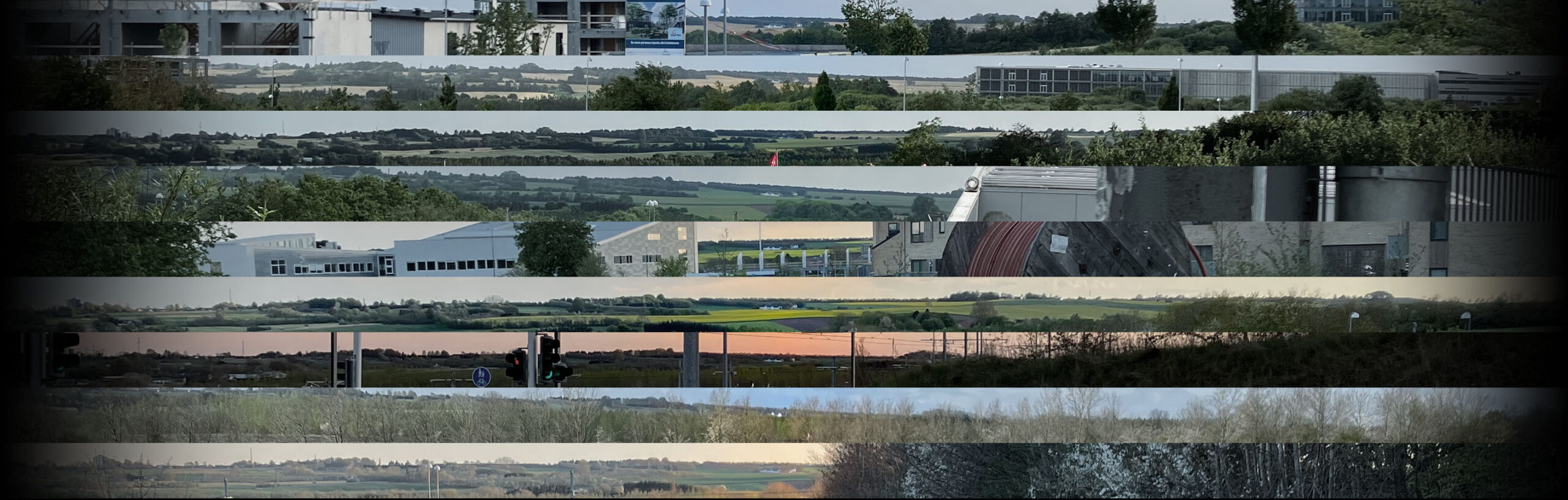
The farmhouse beguiled Keel, riding the limit of his vision upon the distant hillside. It appeared as a ramble of joined-up houses and outbuildings predating the two ephemeral centuries his life had touched. A stand of trees fettered the largest mass, presumably a barn, at one end. The walls were lime white, the roofs orange tile in two shades that didn’t quite agree, like the rooflines. If the tiny, inset windows ever caught the sun, he’d never witnessed it. Maybe there were no longer any window. He was fairly sure he could find the way on his touring bike if he could find the time, but Keel’s time was not his own.
He had a baby now. It was what he’d pined after for so many years, and now it was his, or he its. Only the rocking, crunching flight of the baby carriage–the barnevogn, an expat needed to learn the language–could make the baby sleep. The long walks, at every hour of the day and night, were in a way the freest he ever felt now. The baby came first, second, last, always. This was as it should be, but Keel couldn’t always shake his self-pity, despite the long-ingrained knowledge (his was a late start for a new father) that self-pity is self-abuse.
What of the baby? He was pretty. Not girl or boy pretty, but something entirely its own. Impossibly pretty. Changeling pretty. Somehow he’d never before perceived how variably unnatural babies looked. One neighbor’s child had a face like the rancor. Another’s resembled a grey. Pointed ears, pointed chins, pointed butts… The twins were impossible to describe beyond their rosy cheeks and laughing eyes. Surely the other parents couldn’t properly see what they were pushing in their barnevogner.
The baby gave up his fight with the covers and slept.
Keel turned for home–or the apartment, at any rate. Home was far south in another country. In another sense, home was nowhere, not for years. By the narrowest definition, home was a citadel of new three-story concrete buildings dressed with pre-aged wood (all badly, but each differently) upon an isolated hilltop. Two 19th Century stone barns remained nearby, grand in their partial ruin, girded by chainlink fences. A weathered white brick church marked a waypoint across the big road, surrounded by the bones of a rain-lichened village, barely inhabited if at all. Christmas lights twinkled there throughout the night, but something about their uniformity suggested the contrivance of a town council, developers, or someone else. Seemingly everyone lived in the new developments, which had expanded like a fairy ring until running out of forage in the rocky ground. He knew every way and shortcut by now, every path that could accommodate the barnevogn. The city wasn’t far away, by colloquial reckoning, but it might as well have been in another land.
Flashing its white stripes and blue-black trim in the morning light, a magpie–husskade, he was learning the local names–hopped from branch to bare branch, watching him like an hourly supervisor. Saint Lucia’s day was past. Frosted grass crunched under the wheels.
A meandering fox-run cut through the field, visible now that the hay was cut. Wind-battered chestnut trees clung together in the sandy soil. A stream refused to be diverted by an earthwork, forming a meter square swamp before disappearing into the hill for a stretch and sneaking under the road. Keel’s feel for the dynamism of the landscape kept him engaged through the fatigue. It was something he could neither disentangle himself from nor properly share. He knew it as an inseparable part of him, which suggested a nobility where others found only tedium.
Other displaced fathers pushed carriages along the paths, most lost in the glamour of their phones.
The farmhouse dazzled white and yellow in the frosted distance. Was it inhabited? Empty? A ghost? If a ghost were something impossible to understand, what was a thing impossible to notice? The magpie’s shadow flitted over him.
Continue reading “Eight For a Wish, Nine for a Kiss”