
Recording of the December 8 online premier. Thanks again to everyone who attended.
The Woods in Winter
The third Christmas ghost story by Matt Rasmussen
“I tell these things as accurately as I can, and with no theories to blur the history. Theories are poor things at the best, and the bulk of mine have perished long ago.” -W. B. Yeats

Where the houses ended, the woods began. Neither had a name. The houses didn’t merit one, and the woods could not be encompassed by one. The woods were not merely deep–one might think, endless–but defied one’s sense of scale and order. Wonders were meant to cease. Down the very first path lay a cathedral of pines, tall, solemn and breathless, forever dissolving into the faintest haze. Not far along, three chattering falls met like a fleur-de-lis to run laughing away down a narrow, secretive gorge. Above, a hillside rose, so vast and even that the trees seemed to grow sideways. At the top, a great ledge of quartz split apart to form a silent, mossy inner sanctum. Wander deeper and discover more. The wood’s imagination was never exhausted. The only limits were endurance, and how much one’s heart could hold. Spring, summer and fall, all walked the woods as if in a shared dream. But in winter, no one entered the woods.
In winter, when the shadows of the trees stretched toward them even at midday, the houses became lighted bastions. Visits were begun by early dusk, and lasted until the late light of morning. Candles burned in windows all night long. Snug and warm, these were the hilights of the children’s year, the winter sleepovers with cousins and friends. Good things were exchanged: Principally sweets for the kids, knitwear for babies, and alcohol for adults. Parents stayed up late to sing and toast. If snow fell overnight, it was a good sign for the turning of the year.
Martin and his family didn’t live in one of the old houses, whose small-paned windows scraped the very edges of the forest. Their sashes were of wood, not iron. Their walls were plastered brick, not lichened stone. A boy his age needn’t duck under heavy timbers to move from room to room. The path up their garden bore only a single loop, long overgrown. A hawthorn could be found above the hedge gate, but it was only a carving.
Several houses (which his father called new) faced the roundabout, inside of which had grown up a small stand of beech trees, sparse enough that the lights of the facing houses showed clearly through their paper-white trunks. Whether it was a wood or not, it was here that Martin had first seen her.
She was white, pale as the frost on the grass. “I’m your sister,” she’d said. Her breath didn’t show in the cold.
“I don’t have a sister.”
That’s what he would have said, but Martin knew she’d have shot back, “Are you calling me a liar?”
“Why is your face painted like a fox?”
This, too, he hadn’t asked, but it was just as well. “It’s NOT painted,” she’d have replied.
So little had passed between them. Had he said anything at all? He could remember almost nothing. Questions had been answered without being asked.
A boy other than Martin might have wondered how this could be. A boy other than Martin would have been afraid, or cautious, or at least intrigued. A boy other than Martin would have hesitated to tell his mother.
“You shouldn’t have been out past dark,” she said.
Continue reading “The Woods in Winter”The Meeting House: A Christmas Ghost Story
A frosty Christmas eve
     When the stars were shining
Fared I forth alone,
     Where westward falls the hill
And from many a village
     In the water'd valley,
Distant music reached me
     Peals of bells a'ringing
The constellated sounds,
     Ran sprinkling on earth's floor
As the dark vault above,
     With stars was spangled o'er.

-Robert Seymour Bridges
"Noël: Christmas Eve 1913"
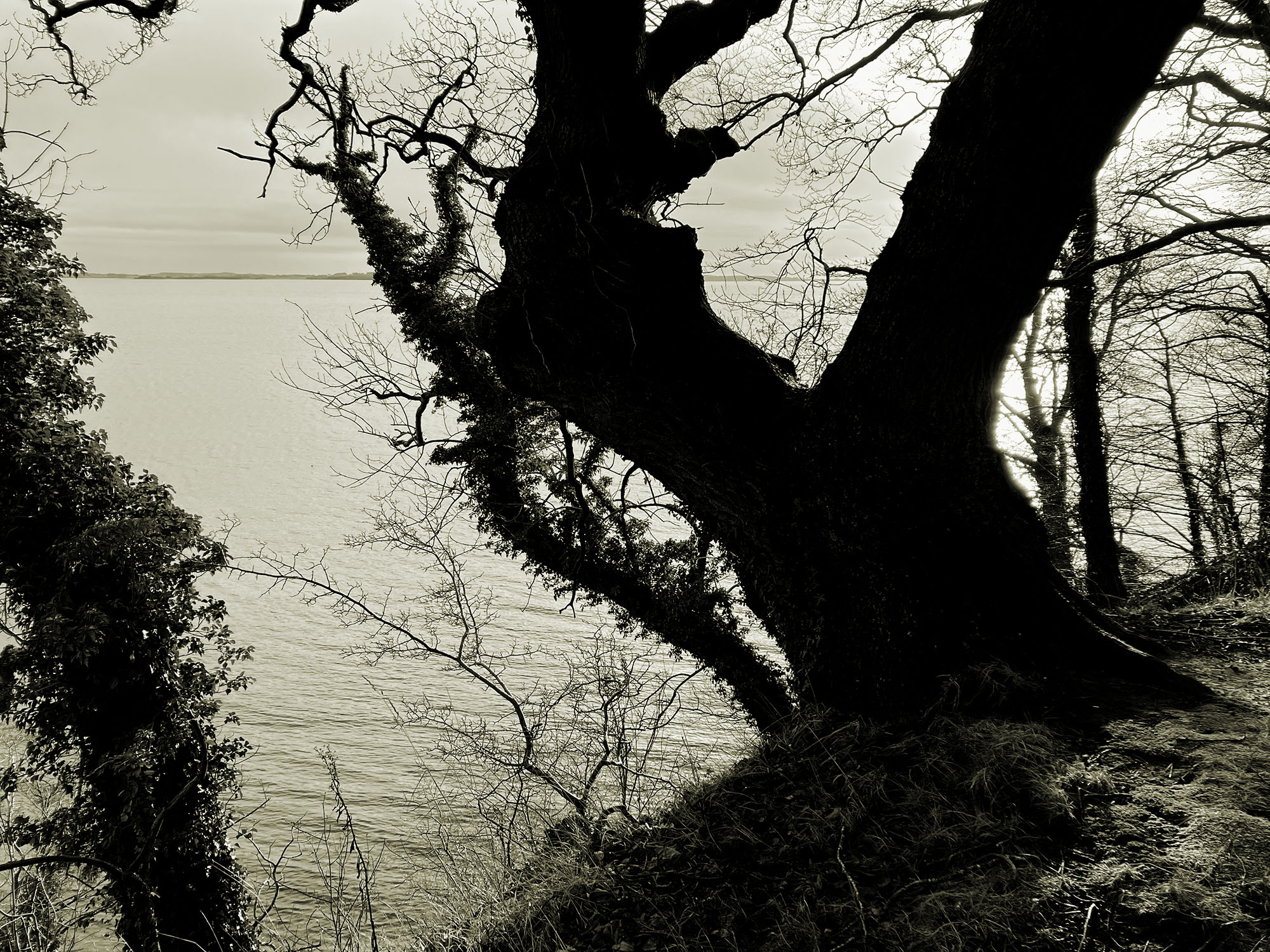
Only once, in all that I’ve spent away from home, have I heard church bells ringing over a town on the night of Christmas Eve. It was in Denmark, and I had been deposited at a stop on the main road. A small village snaked through the dark fields below me, from which rose those clear bells. I was to be the guest of strangers, as often before. It couldn’t have been late. Night comes early there, even in the low north.
Ironically, the acquaintance I was to meet had been made at the height of summer. I recall sitting with three men, pleasantly drunk, not at all following a hushed conversation in Danish, or perhaps dialect. The one English speaker remembered my name well enough: “Geoff with a Gee!” I don’t remember his, having scratched it down only as “J.” It was near 11, but the orange sun hung sluggishly above the horizon, shining through the trunks of a distant copse of trees to inflame the cigarette-stained window of the ancient pub. At some point, I’d mentioned the possibility (then remote) of finding myself that way again at Christmas. My acquaintance had invited me along, in more and fewer words, should the case arise. The men before me were all shadows.
The Meeting House was the second I’d passed, meandering down into the village. As befitting the local agriculture, the new heir to the title had been, effectively, a human pig shed: a low, metal-roofed concrete slab, full of white plastic chairs. The old Meeting House was in every way a contrast. It wasn’t large, but rose to two storeys, with masonry arches above the well-framed windows, and a steep tiled roof. Though also built of greying brick, its age versus the surrounding houses and their large flat expanses was evident at a glance.
A mailbox and wet path up the front yard suggested that the sturdy little building had been subdivided into at least one pensioner’s apartment, but I confess I saw no evidence of this later, and the path may well have led somewhere around behind. Within the privacy glass and drawn blind shone a handful of christmas lights, red and yellow. Someone moved within, momentarily interrupting the pleasant glow. I’ve always been struck by these momentary winter night glimpses into the private lives of others.
But no. The yellow lights were the trick of an approaching car’s headlights. The red were from another that had just passed. The whole effect, including the glow inside, was a confusion of the frosted glass and vinyl blind. The pensioner’s apartment was quite empty, Herr Something-or-other having no doubt gone to his child’s house for the holiday. The other, larger section, showed no signs of life whatsoever.
I continued past the old Meeting House into the village proper: A cluster of houses, garages, a grocery kiosk, and a stone church in the distance. Nothing more. Before the shut-up kiosk, I found my acquaintance with two other men. We were to return up the hill to the Meeting House. He recognized me (“Geoff with a G!”) but I confess I didn’t recognize him. Perhaps he’d shaved his beard, or I was confusing him with another of the drinkers.
Imagine my pleasure when, long before reaching the pig shed, we turned up the damp walkway to the old Meeting House. A rap at the door revealed a clamorous party inside, athough it couldn’t have been 20 minutes since I’d previously passed.
Continue reading “The Meeting House: A Christmas Ghost Story”A Christmas Ghost Story
What do you do the night of Christmas Day? When all the presents have been unwrapped, the food eaten and the visits made? There's an old tradition, predating M.R. James and Charles Dickens, and even the author of Gawain and the Green Knight. I think we should bring it back: The telling of ghost stories.
Cantwell had never taken the time. Another version of her would have assumed that she knew what a ghost was. The present Cantwell was rarely the type to bother with abstractions. What a ghost was cost her no more concern than the question of what a friend was. Were either real? Her friends demonstrated fealty on the right apps and were present in person when circumstances required. This sat comfortably enough in place of a definition. Likewise were ghosts considered by some influential people (and what other kind existed–meaningfully existed?) to be a thing one could accept as “real.” Our alternate Cantwell would have said that a ghost was what remained when a person had otherwise died. They symbolized the inevitable loss of beauty and influence that preceeded the grave by so many years (for those who couldn’t contrive to go out on top) but were otherwise nothing more and much less than a person on this side of the ground. The thought of meeting a ghost hadn’t crossed Cantwell’s mind since she had been very, very small, and understood very, very little.
This Cantwell, the present Cantwell, got by with surface glosses in place of understanding. Understanding was a thing that lived in a stillness she simply didn’t inhabit. She felt naked without a constant crush of attention from all sides, like some deep sea chamber that would rupture if brought to the surface.
It came to pass, however, that she found herself in just such an unaccustomed stillness passing the canal opposite Christiansborg. Her devices were as silent as the unseen water below. Given their use during the day’s brief sunlit hours, this was not mysterious, though car headlights somewhere in view would have been more usual. The silence ate at her much more than the darkness and the cold. Thoughts echoed that didn’t feel like hers.
She was not precisely in her right mind, if one can ever be said to be. An unsettled mind is usually crosscrossed between past conditionals and possible futures, in Cantwell’s case none more than 48 hours in either direction, but hers was also occupied with several alternate presents where others had granted or withheld one thing or another.
Cantwell had a place and time to be, and was hating it as much as the remainder of the present void. The city could be any city of sufficient cachet to her; she didn’t speak the language and didn’t care to, for they spoke hers. Places were backdrops, set dressing. The bare black stage around her was growing intolerable. It was, in fact, the longest night of the year.
There was another, opposite her. A ghost.
Continue reading “A Christmas Ghost Story”