Junk Mail Art

Issue 159, for the week of 11/27/2005.

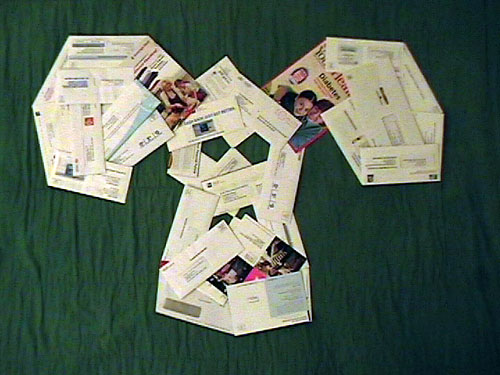
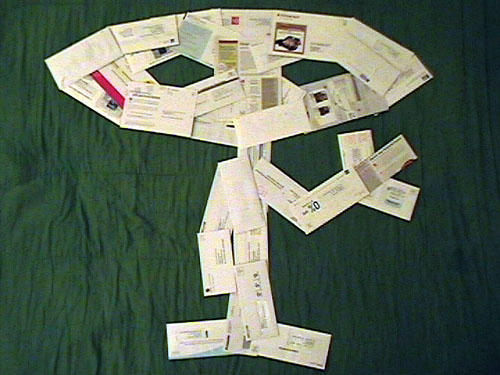
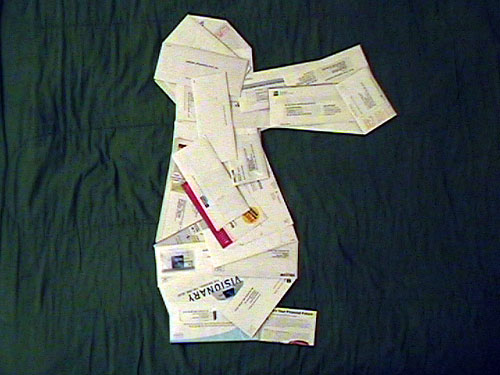
Toast Note: Failing to produce a real Space Toast Page tonight, I got playing with junk mail a little after midnight (it’s now close to 3AM). The medium represents an inexhaustible resource, and I’ve been endeavoring to come up with uses for it lately. The following pieces are assembled out of what junk mail I’ve accumulated since the blinds project. (More on that later.)

Lem’s Bunny, from the web comic of the same name. It’s been submitted in a slightly different form to Bunny’s Warren, the section for fan-made strips.

The Marboxian. It had to be done.

Finally, Berkley Breathed’s Opus, who in my world needs neither introduction nor invitation.

Notes on Admiral Bulletin and the Internet Elucidation

Part I: The Origins of the Admiral

First Note– In 1962, when it looked like no more Bulletin books would be written, Judd Harkins retired the characters with an engagement and an indicated Eppings on High Street wedding. When the Cerf Publishing Group relaunched Bulletin the following year, the betrothal was explained away and disposed of. (The “engagement” scene in empty Paddington Station had been staged for the eyes of the villain, although fans have pointed out some logical inconsistencies with the notion.) In Bulletin’s aired appearance on the Saturday morning cartoon series Defenders of the Earth (Episode 121, “The Lost Ship”), Bulletin was depicted raising a son with Miranda on a farm they’d improvised in the lost recesses of the Congo basin. Like fans of the other King Features Syndicate characters used in the show (Flash Gordon, The Phantom, Mandrake the Magician, et al) few Bulletin fans regard the episode as canonical.

Second Note– The original lines, as written by Peter Stepford (Admiral Bulletin and the Turning Sea, First Edition, 1932. Page 214):

“There’s no time left!”

“I said bring her hard a-port!” the Admiral shouted.

“Into the minefield? Are you mad? There isn’t berth.”

“There must be!”

Part II: The Golden Age

First Note– MacRae, Jodi (Judith Mankiewicz) “Backstage at the Bulletin”, The Observer, Feb 12, 1993. Packard’s trial records refer to his mother’s house on Wentworth Street in East London. This meshes with the address given by Packard in his contract with Glencannon Press.

Second Note– The number is somewhere between 289 and 314. If you have your own copy and want to count it, page by page, please… be my guest.

Third Note– There is some debate about when exactly the Golden Age ends. Bulletin’s hiatus from novels between 1939 and 1941 is often considered its logical end. Many fans, myself included, believe that the daily strip storylines continued the best Golden Age traditions well into the 1950s, but I disagree in asserting that this makes them true Golden Age works. (Though I have some affinity for the “Silver Age” nomenclature. Don’t send letters though; I’m not going to use it in the essay.)

Part III: Admiral Bulletin and the Daily Strip

First Note– Hartley illustrated trades of Stevenson’s Treasure Island, Dumas’ The Count of Monte Cristo, Wells’ The War of the Worlds, Verne’s Five Weeks in a Balloon, and probably one or two others. I’ve seen a few scans of his early work, and while its not on par with the Brandywine school artists, or even Hartley’s own later Bulletin strips, it’s worth a look.

Second Note– Hartley’s tradition endured with such remarkable force that when in 1967 Marvel comics based a major plot point of revealing Miranda’s face (“Admiral Bulletin #32”) public outrage in Europe was so intense that the authors were forced to backpedal with a plotline involving a double. The later Image comic would not make the same mistake.

Third Note– Personally, I think he was trying to cover his butt. I have trouble believing that Hartley’s flair for intrigue didn’t spring from a fair dose of real-life paranoia, and Glencannon Press’s management wasn’t always one to honor its agreements.

Fourth Note– Increasingly off his leash, toward the end of his Bulletin’s run, Stackpole’s artwork began to slide into very baroque territory. Fantagraphics (who is doing an amazing job with Peanuts) is planning to release the Bulletin Strips beginning in 2007. These will be full hardcover editions, unedited, and otherwise just about everything the old ’70s trades weren’t. I haven’t figured out if Fantagraphics has the “lost” Stackpole strips, but I’m keeping my fingers painfully crossed.

Part IV: The Turbulent Years After/Colophon

First Note– I’m basing this on Silvestri’s introductory essay in issue #1. He seems to have known Bulletin by the ’70s collection of daily strips. I’m not really sure how old Silvestri is, but I’m guessing he wouldn’t remember the strip when it first ran, and he doesn’t mention the books in his intro.

Second Note– Marvel didn’t have the rights to the A. C. Vellum pseudonym, and it was not used on the Admiral Bulletin comic book series.

Third Note– I hadn’t really found a better place to put this, but a biographical sketch of Robespierre by Nigel Hartley is known to exist. It’s been floating around with fans for years. This comes courtesy of Troy Minkowsky, OfTheAtomic:

“The Tragic Tale of Robespierre”

Robespierre Cholmondeley was born in Vezelay France, the only son of a watchmaker. At three years of age Robespierre started showing inhuman skills, such as transformation and being able to read the future. He was discouraged by his deeply Catholic parents to display his talents and suppressed them. It was not until he turned sixteen when Robespierre used his powers to save his girlfriend from a burning building. This caught the eye of the French Government. 

At age seventeen Robespierre earned special agent status in the French government. He dealt with threats to France an of occult nature. A significant tool for many years, his loyalty came into question when word of his involvement with the French Communist party leaked out. The accusation was only a half truth, for it was RobespierreÕs girlfriend who was the Marxist. While no longer trusted, yet still a valuable tool, the French Government recommended him to a special tasked force formed by the Brits. The head of this taskforce was one Admiral Bulletin. 

The two soon became quick friends. Both where child prodigies, Robespeirre a high Shaman at age twenty-three and Bulletin commanding his own fleet at twenty-six. The two had a great love of sport, cinema, and the ladies. The only time the two argued was over chess and women. 

Their first mission together was a voyage to the deep heart of the Congo. A British trading post was attacked by a Snake Goddess and it was up to them to restore order. Foolhardy with a sense of invincibility that could be blamed on youth, the two rushed in. 

The Admiral lost thirty men when the fleet was attacked by giant Congo-Serpents . Robespierre was held captive by the Snake Goddess for two months before Admiral Bulletin was able to set him free. With what was left of his strength Robespierre was able to banish the Serpent Goddess into another dimension, but not without a price. His head started to fall apart, chipping away, and the chaos magic inside him began to spill out. No longer alive, yet not quite dead, he existed in Limbo. 

He fled to Tibet, wishing to spend the rest of his existence in solitude, but it was not to be. For his good friend Bulletin was organizing a group of people with extraordinary powers to save the world, a mission Robespierre could not resist.

Still More Human Resources

Issue 158, for the week of 10/23/2005.

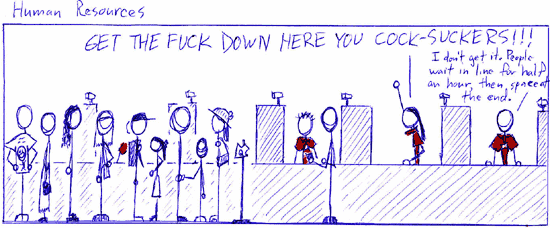
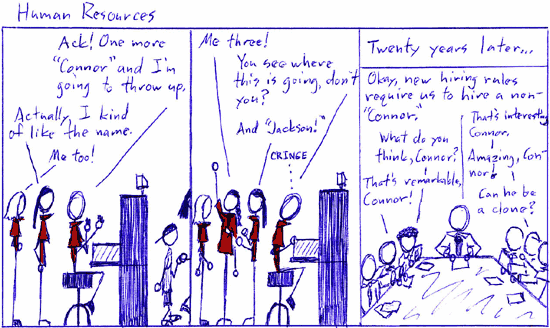
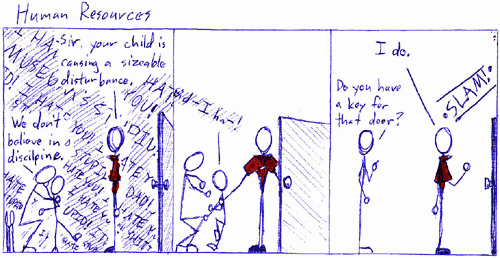
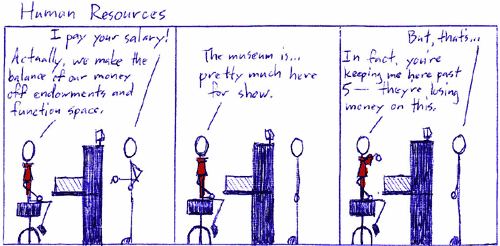
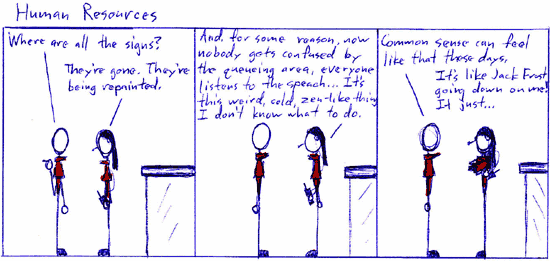
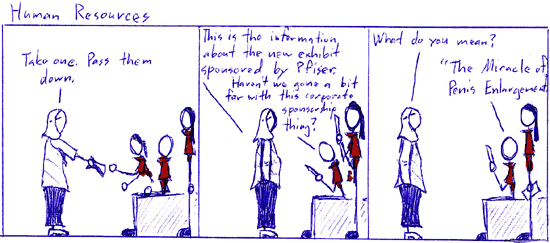
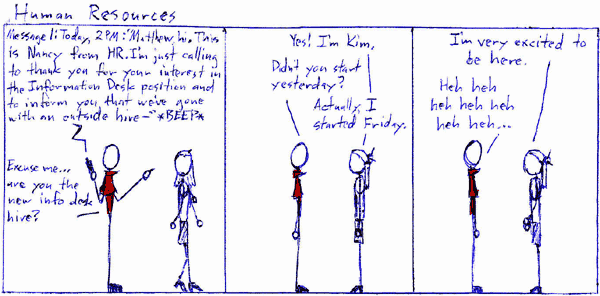
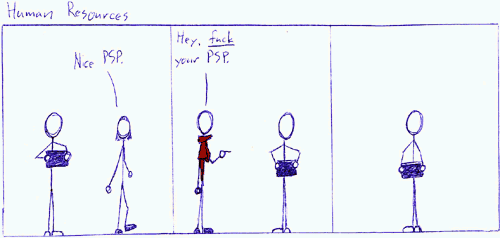
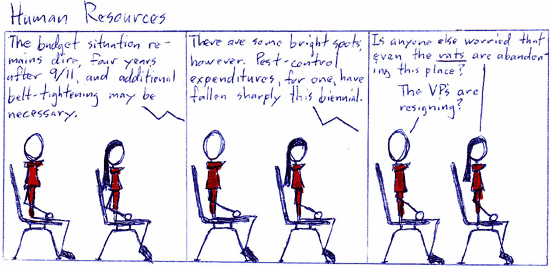
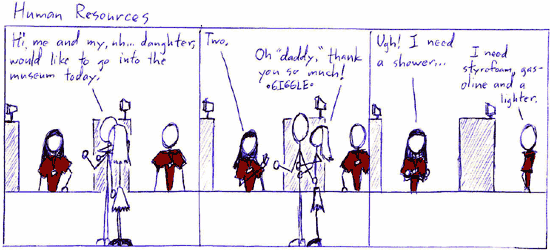
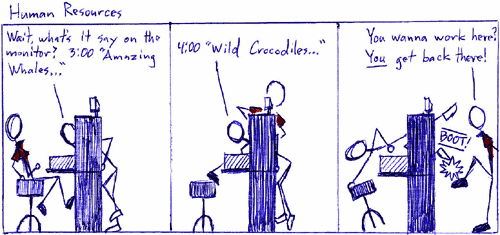
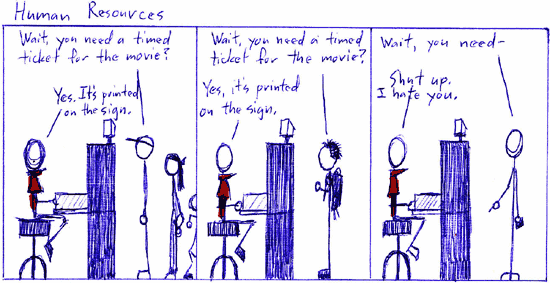
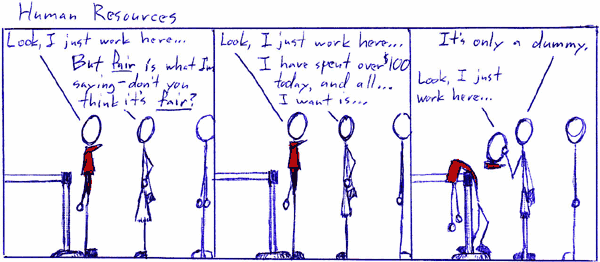
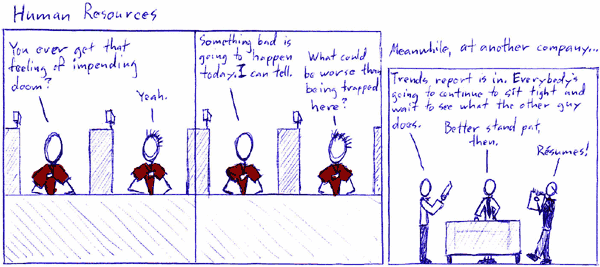
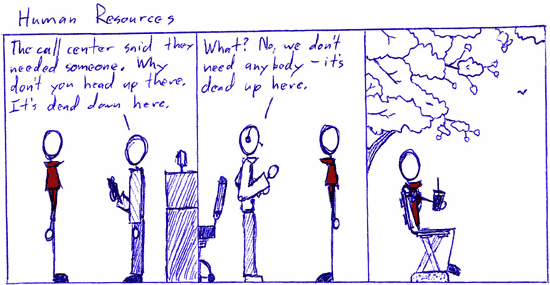
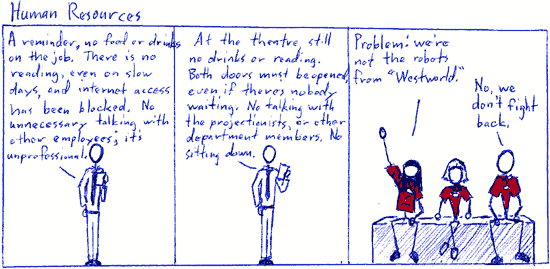
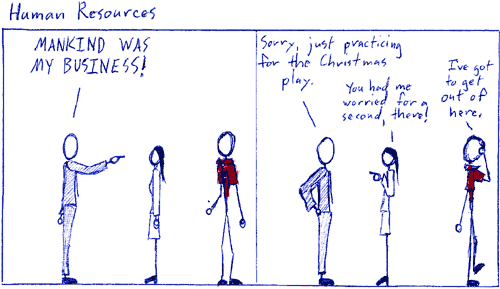
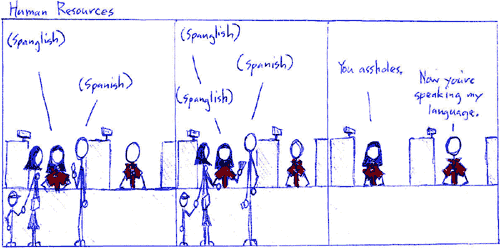
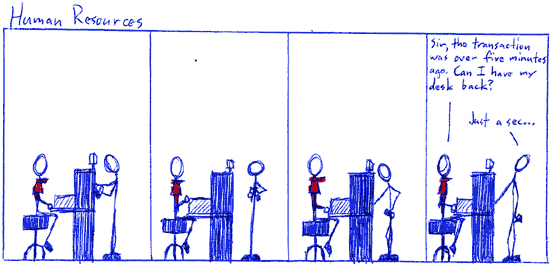
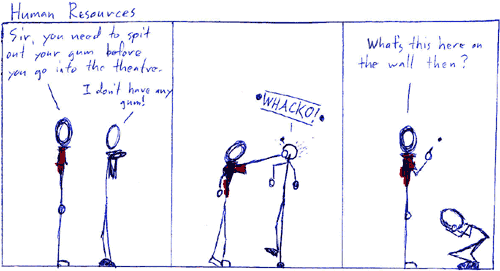
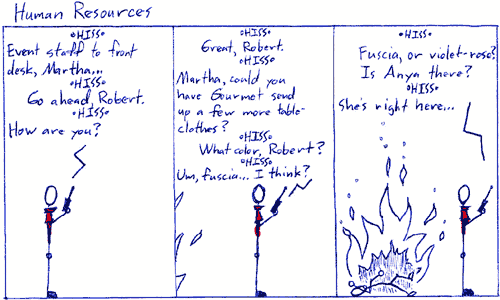
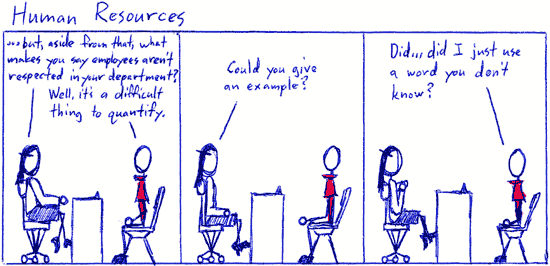
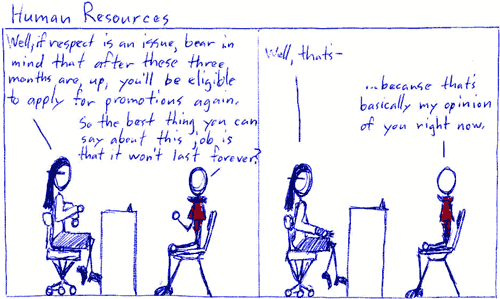
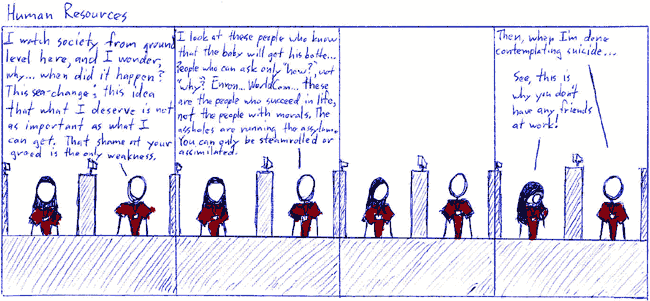
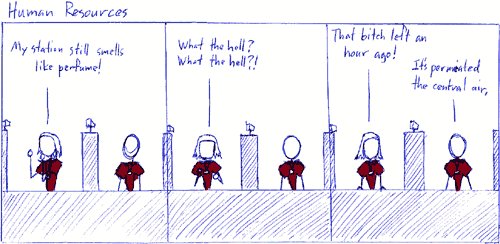
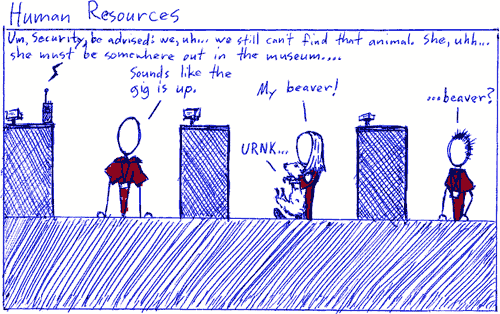
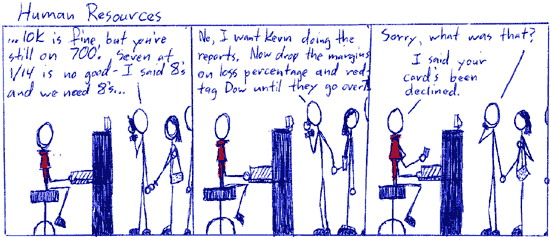
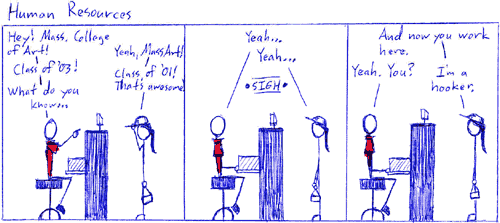
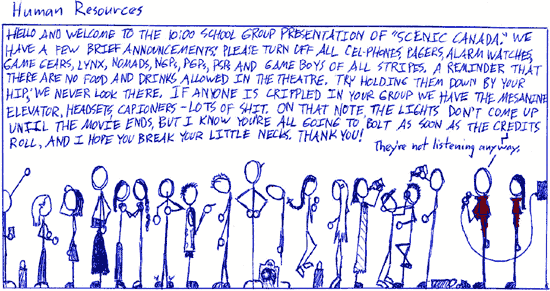
Toast Note: Presenting “Human Resources” comic strips 26-41. (Click here for Strips 1-11, in issue 145. Click here for Strips 12-25, in issue 149.) Medium: Blue ballpoint pen (museum issue) and red magic marker (museum issue) on recycled note pad paper (museum issue), improvised straight edges (museum/personal issue). Dedicated once again to the wage slaves of America: “vagrants amidst the plenty.“

Admiral Bulletin and the Internet Elucidation, Part IV

The Turbulent Years After

Glencannon transparently ended an era with publication of its last Bulletin book, Admiral Bulletin and the Eudoxian Delay, in January 1954. The publisher never really recovered from its losses in the war of the previous decade. Infighting and incompetent storycraft had already crippled the venerable pulpmaster, and Hartley’s killing of the daily strip sealed its fate and its doors. The book itself was a wild, disjointed cutup of much that had come before in Bulletin’s swiftly-turning planet, with far too much Space Boy for its own good. (Call it the Scrappy Doo Syndrome, or the Inevitable Gizmoducking.) Rob Cohen likely wrote it, as he’s the only name shared between Glencannon Press and Masterbooks, who bought up Bulletin and much of the wreck of the older publisher. Masterbooks continued the worst traditions of the later books, depleting the property further of its apparent value. Cerf Publishing Group itself bought Masterbooks in 1965, and after a cursory two-book relaunch pretty much left the Bulletin series to swing.

But this was not the end of Bulletin.

Bulletin returned a few short years later, in America, in the pages of a self-titled Marvel comic book. Of note is “The Return of the Hydrator,” issue #12, wherein none other than a pre-Star-Trek Harlan Ellison posed the questions of a masked marauder unleashing a net positive effect on an unsuspecting populace. (It should be noted that there is no “Hydrator #1,” though I’ve met people who swear they’ve read it.) “Admiral Bulletin” was published irregularly after the first two years, and officially cancelled in 1970.

But this was not the end of Bulletin.

A swell of interest brought back several of the Bulletin books in paperback form, in the mid seventies, as well as a three volume “Best of…” collection of Nigel Hartley and Teddy Stackpole’s comic strips. Most readers prior to 1997 remember Bulletin this way. Some think he was created in the mid seventies. Alas, like all swells, there was a trough to follow, and Bulletin fell back out of print in the United States and Great Britain for another two decades.

But this was not the end of Bulletin.

In Italy, where Bulletin still enjoyed a measure of popularity, a tv series was begun in 1979. Armando Barsotti played the Admiral, with Ingrid Soft as Miranda. The cast and setting were Italianized, and by accounts the show was campy and played mainly for comedy. It was released on VHS-PAL, in Italian, and there are no official subtitled versions. The show ran for two seasons, beginning in the spring of 1979 and ending in 1980.

But this was not the end of Bulletin.

Upstart creator-owned imprint Image Comics brought out its own, darker version of Admiral Bulletin in the fall of 1994. Marc Silvestri, a founding partner in the Image venture, was the apparent driving force behind the relaunch, although the art and story chores were passed off to Brandon Peterson and Norman Schultz, respectively. Similar in tonal change to Mark Gruenwald’s ’80s writing for Captain America, Schultz’s Bulletin had become a “contractor,” privatized under the blind Thatcherism/Reaganomics push of the previous decade, embittered, emboldened and dangerous to be on the wrong side of. Bulletin had come a long way indeed. Much like the previous Marvel attempt, and indeed the rest of the Image stable in the early years of its existence, this Admiral Bulletin was irregularly published. In 1994 it became a victim of Silvestri’s Top Cow/Image split.

But this was not the end of Bulletin.

Bulletin’s most recent sighting has been with Vintage Books, part of the behemoth Random House Group. In 1997, Vintage brought out three trade paperbacks in Great Britain:  Admiral Bulletin and the Western War,  Admiral Bulletin and the Foreign Star, and  Admiral Bulletin’s Last Exchange. Fan excitement quickly waxed, however, when the American publication failed to materialize, and a promised Admiral Bulletin and the Jungle Gods was delayed until 1999. As of this writing (October 2005), the final promised Vintage reissue,  Admiral Bulletin and the Cretin Conspiracy, has materialized on neither side of the pond, and all references to it on the Vintage web site have disappeared.

But this is not the end of Bulletin.

Colophon

Maybe the world would be just the same without Admiral Bulletin. Biggles didn’t need an older brother. Flemming didn’t have to perfect Packard’s odd little experiment in “The Quantum of Solace.” After Glencannon Press folded in 1954, no one ever made any money off the Admiral — certainly not Image or Marvel. Miranda’s obsessive filing of the strange and inexplicable in the old vault at Eppings on High Street may not have been the germ of the warehouse scene at the end of Spielberg’s Raiders of the Lost Ark. (He’s never claimed as much.) Who’s ever written a Bulletin novel — or even short story — to later win fame and fortune writing under his own name?

But maybe, just maybe, we do need Bulletin. Bulletin gives us something we lack. He’s certainty. He’s chance as a foe and a friend. He’s the reason we never wanted to play the bad guy at cops and robbers. To different generations, he’s been different things; ironically, it’s his inherent rigidity and stability that makes him such a foil for our preconceptions. Image made him one thing. Masterbooks another. Squabble as we will over what is and is not cannon in Bulletin’s convoluted universe (Did Robespierre die in Khartoum, the Mirage Islands, or not at all?) we will be missing the point unless we remember that neither the future nor the past of Admiral Bulletin has been written.

He is what we make.

*****

Special thanks to Isaac Salleo (Wesl.d.Amor) for corrections and additional dates, and to Troy Minkowsky (OfTheAtomic) for typing up the Robespierre bio. Dedicated to all Bulletin fans worldwide. The author of this page makes no claim of copyright over “Admiral Bulletin,” “Miranda,” “Eppings on High Street,” “Dr. Posthaste,” “Robespierre,” or other related Bulletin characters and properties. Please contact the author with any corrections, additions and the like.

Admiral Bulletin and the Internet Elucidation, Part III

Admiral Bulletin and the Daily Strip

On Christmas Day, 1937, Admiral Bulletin debuted as a three-panel daily comic strip, joining a field already crowded with established players like Chester Gould’s “Dick Tracy” and Lee Falk’s “Phantom.” The art and story were the creation of Nigel Hartley, who brought a love of intrigue and a distinctive crosshatched Art Deco style to the endeavor. The strip was an international success, launching the following Valentine’s Day in the United States under the King Features Syndicate banner and eventually appearing in twelve languages across five continents. During the war, Bulletin dutifully chased spies from one end of the Allied theatre to the other, and Hartley continued work from his family home in West Somerset, though readership declined of necessity. It was, however, Hartley’s departure in 1952 that ended Bulletin’s long afternoon in the daily funnies.

Nigel Hartley was a Guardian of Manchester op-ed cartoonist and illustrator of juvenile adventure books before joining Glencannon Press. He is the creator of Bulletin’s London headquarters, referred to only as “the old currency bank” until Tad Maplethorpe’s 1942’s Admiral Bulletin and the Shadow at Oxford. The various employees and hangers-on of Eppings on High Street grew under his tenure as well. Hartley expanded one of Turner’s characters into the Robespierre we know today. He also created a “pre-decadence” version of Space Boy. Perhaps the most enduring trademark of Hartley’s comic was its most deliberate omission: In fifteen years, the strip never once revealed Miranda’s face. The character’s low-slung felt hat usually accomplished the trick, but when the hat proved inconvenient Hartley could draw from a seemingly bottomless bag of tricks. Shading, hand position, torches, and — in one memorable scene — mistletoe were among Hartley’s many tools of evasion.

Hartley’s eventual departure was predictable, given the history of Glencannon Press. In the original launch of the Admiral Bulletin strip, the headline had read: “By A. C. Vellum. Art by Nigel Hartley.” This was, of course, something of a diminishment of Hartley’s contribution, and he likely threatened to quit. With King Features Syndicate aggressively pushing Bulletin in the United States, and sales of the Bulletin books exploding, the editors changed the headline to “By Nigel Hartley and A. C. Vellum.” Hartley also began disguising his signature in the artwork at about this time. It was a touchy arrangement that never seems to have satisfied Hartley. In addition to his byline woes, Hartley was under constant pressure to conform the strip’s storyline to that of the books. By the early ’50s the books had taken on a sci-fi slant that bore little resemblance to the slow-burning urban intrigue that Hartley excelled at. The final straw came in March 1953 when ailing Glencannon Press sent Hartley a printed comic-script for the next four months in an effort to promote Admiral Bulletin and the Eudoxian Delay. Hartley had had enough, and quit.

His assistant Theodore Stackpole continued in his style for another five months, but readership fell off. Admiral Bulletin was cancelled in August 1953, with a month of Stackpole’s strips remaining. They haven’t been published to this day. Glencannon Press itself would dissolve within the next year, throwing Admiral Bulletin into the Turbulent Years After.

Admiral Bulletin and the Internet Elucidation, Part II

The Golden Age

Though some still prefer not to accept it, there are few who could have matched George Packard’s qualifications to con A. C. Vellum’s name for 1933’s Admiral Bulletin and the Phoenix of St. Helena. A one-time contributer to the London Weekly Traveller, he’d visited the titular island in the 1920s and been on holiday for four years preceding the book’s writing — if serving a sentence for mail fraud can be referred to as “on holiday,” that is. As Jodi McRae of the Weekly Standard proved in 1993, Packard, a convicted con man, was indeed the same George Packard contracted by Glencannon Press in 1932. Seen in this light, Packard’s colorful history meshes perfectly with his Vellum writings.

Structurally, Admiral Bulletin and the Phoenix of St. Helena is a three-way conflict between a mysterious man obsessed with becoming the next Napoleon, Bulletin and his team, and a lovable/hateable con named Drinnian. It’s been seriously proposed that the final is a semi-autobiographical character. Drinnian’s schemes are uproariously funny, only to turn darkly bitter in his memorable final two scenes. Neither virtuous nor truly villainous, he plays the “grey center” that would become a recurring theme in many of Bulletin’s finest outings.

Packard continued to plumb the “grey center” to great effect in six successful books and thirteen short stories. The villain in 1934’s Admirable Bulletin and the Bombay Incident, while amassing the highest body count of any Bulletin foil up until then, reads like something approaching a tragic hero. In Admiral Bulletin and the Foreign Star, released in 1937, Bulletin falls victim to his own preconceptions regarding an ally from one of Stepford’s short stories. Packard’s “Admiral Bulletin and the Saipang Sting,” published in the May 1938 Cosmic Significance, runs Bulletin into some of the darkest pre-Image territory of his career, forcing Miranda herself to become essentially the hero.

Packard’s reinvigoration of Bulletin was well under way when Clifford Turner released his first Bulletin book in 1935.  Admiral Bulletin and the Desolate Rail brought Miranda squarely to the fore, forcing her to make resonant, human choices in an era of adventure writing still characterized by Lois Lane and Wilma Deering. Turner is credited with the creation of socialite occultist Lady LaChance and bush pilot Buggy Moran (both in 1936’s Admiral Bulletin and the African Rose) and the alien(?) cargo cult the Brake Men (in “Admiral Bulletin’s Lost Day,” published in the July/August 1938 Curious Tales). Turner liked to mine and cross-referencing earlier stories. He corresponded with the other Vellum authors, including Packard, to orchestrate plot and character lines that ran across multiple works, lending the Golden Age Bulletin books a sheen of saga.

Unfortunately for Bulletin, the real world was quickly encroaching on his world of cloak and destruction. The bombing of Glencannon Press’s offices in the Battle of Britain destroyed the company’s three largest printing presses, leaving them limping along with two smaller presses in Manchester. Clifford Turner entered the war as a tank mechanic, and was killed in North Africa in 1942. It’s not known exactly why Packard didn’t go to fight; after publishing “Admiral Bulletin and the Exact Timetables” stateside in January 1942’s Readers’ Digest (it was probably written earlier), he disappeared from public view until 1955, publishing two respectable detective novels and then retiring from writing altogether. Only three Bulletin novels were published between 1939 and 1945; the War had brought the Golden Age of Bulletin to a close. True fans — increasingly to be found abroad, and especially in the United States — were left to content themselves with the incomparable Nigel Hartley’s newspaper strip.

Tentative Title: “Class Day” – Jack Scully

Scene 0:

[Fade in on the intercom. ]

THE PRINCIPLE’S VOICE: …should not have happened. And finally, on this class day, our congratulations go out to Mr. Goomba’s automotive class, who successfully took apart Financial Administrator Johnson’s Ford pickup yesterday and reassembled it on the roof. The administrators then responded by car-bombing Mr. Pickford’s new Pontiac outside of his science class, in turn causing the front office to be mail-bombed by the teachers, resulting in a slew of gunshots fired into the teachers’ office, which set events in motion which resulted in the bombing of my house, to be responded to with a strong letter. Also, the chess team will be meeting after school, and Mr. Horovitz reports that the nuclear reactor in the science lab is almost operational. That is all.

Scene 1

[By he doors to the main entrance of the school, the lone figure of PARKS stands. He has a pack on his back, and prefferably a pith helmet. ]

ANNOUNCER: [The voice of adventure, rather stuffy, perhaps British. ] …And so our hero, Sir Walter Parks Raleigh, 11th grader and captain of the chess team, sets out on an arduous journey. He must, at all costs, find the man who raped his hamster, Fluffy, and return before third period. [Quick cut to the hamster in question. ] Fluffy is said to be recovering nicely, though he hasn’t touched his food for most of the day. [Back to PARKS. ] With this in mind, our intrepid hero leaves behind the sweet confines of civilization, and goes off into destiny.

[As he walks off down the hallway, a paper airplane flys past the back of his head. A brief montage of innovative shots, many dramatic and slow-motion, of PARKS walking follows, overscored by dramatic music. At the end, PARKS stops and looks up. A shot, similar or identical to one of the first shots follows, revealing that he has travelled all of ten feet. ]

ANNOUNCER: Our hero realizes that this journey may become even more arduous than he at first assumed, and heads off for snacks. [PARKS turns and goes into the cafeteria. ]

Scene 2

[At the vending machines in the cafeteria. Parks enters, trying to crumple a bill into machine-usable condition. Three or four students appear from between or behind the machines, or off-camera, and waylay him. Some have spears and shorts, others guns, dark shades, and white tee-shirts. They carry him offscreen. The announcer’s voice continues underneath. ]

ANNOUNCER: He is then waylaid by giant Pigmies and 1950’s Cuban Communist revolutionaries.

Scene 3:

[PARKS is dragged by a Cuban revolutionary and a pygmy, fighting unsuccessfully, deeper into the cafeteria. He stops, and his eyes bug out. ]

PARKS: You!

[Reversal to the Cuban Communist revolutionary leader in a heavy khaki shirt and dark shades sitting, fingers crossed, at a folding table, flanked by his men. His men are in similar dress, and are all quite a lot bigger than he. ]

LEADER: So, we meet again. [Evil laugh. His men catch on after he is done that they should have been evil-laughing too and do so, but quickly stop. ]

[Back to PARKS, etc. ]

PARKS: But… but you’re the hall monitors-! What is this-? Why are you doing this-?! Where did these pygmies come from?!?

[Several characters, in turn, in close-up say: “Pygmies?” The pygmies then look at each other, scream, and run away. ]

ANNOUNCER: The pygmies are terrified of themselves, scream, and run away.

LEADER: Now then, getting down to business… You have been charged with trespassing on the lands of the independant state of Ezbulistan, founded at around 8:30 this morning, and extending from approximately over there, to about where ever else we want it. These charges being true, you must be executed. But first, [Addressing the seated spectators. ] any old business? No? Any new business? Very well. Comments from the public?

AN OLD MAN: Yes, I’d like a sewage system.

LEADER: No.

[Random requests from all over the school, such as… ]

MAN WITH A TOWEL AND SHOWER CAP STANDING OUTSIDE THE BOYS’ BATHROOM: I want a sauna.

JOCK STUFFING A FRESHMAN INTO A LOCKER: I want bigger lockers.

GIRL: I want a man.

BOY: I want a man.

TWO INTERPRETIVE DANCERS: We want… love! [At which point they are trampled by the giant pygmies in their desperate attempt to flee. ]

BOY: I want powdered wigs to come back.

BOY DRESSED IN A GIRLS’ CHEERLEADING OUTFIT: [Becoming suddenly self-conscious. ] …no, I’m fine.

–

LEADER: Very well, we shall begin the trial. Do I think you’re guilty?

PARKS: Yes.

LEADER: Then you are. Guilty as charged!

[All the previous “request” people gasp in sequence, including the interpretive dancers who the pygmies then trample again, coming the other way. ]

LEADER: [Laughs his evil laugh. ]

[The head of the Ezbulistan Department of Tourism then interrupts. He is wearing a sport coat and carries a hand microphone. He has his own light. He seems out of breath throughout, as if trying to keep up with the camera. In every cut, he has to get back into the shot. Nevertheless, he tries to put the best spin on things. ]

TOURISM: But, before we head over to the execution, I wonder if we might – take a moment to examine the many natural and artifical wonders – that greet you on a wonderous Ezbulistan vacation…

Scene 4

[A “Wet Floor” sign, by a puddle of water. TOURISM enters quickly. ]

TOURISM: See – the many rivers and streams of Ezbulistan’s national waterways.

Scene 5:

[By a potted plant. ]

TOURISM: – Thrill to our National Forest.

Scene 6:

[Two people play at a pingpong table. ]

TOURISM: For the sports enthusiast, Ezbulistan features a multitude of recreational outlets – and sporting clubs.

Scene 8:

[A single saxophonist butchers a few notes to a radio playing softly behind him. ]

TOURISM: Enjoy an evening with our national band.

Scene 9:

[A shot that shows most of the cafeteria. ]

TOURISM: [walking ] Yes, Ezbulistan; truly a vacational treasure. [Some smiling people join him from behind. ] And now, back to the exciting execution of the first foreigner to enter our country.

Scene 10:

[Low angle shot. Inside the auxilary gym. A bit of wind ruffles PARKS’s hair, accompanied by a more substantial sound effect. He stands proudly, arms tied behind his back, awaiting the inevitable. Shot widens to show his executioners – armed revolutionaries, ceremonially preparing to push him off the precipice. Wider shot for a moment, revealing that the drop off the bleachers is none-too-far, and cushioned at the bottom. ]

EZBULISTANIAN 1: You are charged with crimes against things.

EZBULISTANIAN 2: Yeah.

PARKS: So be it.

Scene 11:

[The desk with the LEADER and high officials of Ezbulistan. ]

Announcer: Meanwhile, a coup d’etat is underway in the state of Ezbulistan.

[A rubber chicken flops onto the desk before the LEADER and his high officials. They regard it with curiousity. Suddenly, it explodes (digitally). Afterward, the table is empty, the pygmies run on, cheering, and assume power by sitting down. ]

Scene 12:

[Back to the execution. ]

EZBULISTANIAN 1: Have you any last words?

[PARKS looks on nobly, and then looks startled, camera fast zooming-in on his face. ]

PARKS: You!

[Fast zoom on a lone, evil figure in the corner. The EVIL MAN chuckles. ]

PARKS: Wait! [But he is pushed off. The drop takes an excessive amount of time, the sound track, in fact, seeming to be paused while the men watch him fall. And they watch him. And they watch him. Just at the last possible funny moment, we hear him hit the mat (far) below. ]

Scene 13:

[A grainy, slow digital zoom on the rodent. A new, stuffy, but tension-filled announcer quickly voices-over. ]

ANNOUNCER 2: This is the story of one rodent’s courageous battle against the confining confines of society. Of what one hamster can be forced to do when no-one else is in its corner. A story beyond boundaries! A story of high drama! A story of sin and more sin, of love/hate/joy/lust/perversity, and above all, a devout lack of pygmies.

Scene 14:

[An on-the-floor, wide angle shot looking up, somewhere in the hallway. The EVIL MAN enters, and looks down at a spot on the floor just in front of the camera. ]

EVIL MAN: [sneering ] So… it’s you. Back again, are you..? What’s that behind you? [A standard revolver rises into the shot, just in front of the camera. ] Oh I see… You haven’t got the guts, though. You… a simple hamster, you haven’t got the guts!

[The gun fires. EVIL MAN falls out of the shot, dead. The gun looks suddenly to the right. ]

SCIENCE TEACHER’S VOICE: No no, not yet!!!

[A nuclear blast rips across the frame from right. Cut, briefly, to a shot of a nuclear mushroom cloud. ]

Scene 15:

[Somewhere in the school. ]

TOURISM: And so ends – our exciting story. Brought to you by the Ezbulistan Department of Tourism. Who would like to remind old friends and new that –

[A rubber chicken flops onto the floor in front of him. He looks at it. Quick cut to an exterior explosion shot, such as the federal building in the X-Files movie. ]

Credits:

[PARKS lying motionless, face down on the mat. He remains there, motionless, all through the excesively long credits. Finally, after the last title has scrolled off the screen, he raises a hand. ]

PARKS: [muffled ] I’m fine.

Admiral Bulletin and the Internet Elucidation, Part I

The Origins of the Admiral

The long and often contradictory history of Admiral Bulletin is indivisibly linked to one man: A.C. Vellum. There’s only one problem. He doesn’t exist.

“A.C. Vellum,” along with Franklin W. Dixon of the Hardy Boys fame, and numerous others, carries the card of that exclusive shadow club of authors who’s output — though impressive — is more real than he. The Vellum name was registered by Glencannon Press of London, UK in 1923. He first appeared as the author of a small line of “Red” pulp-detective books (Red Rover, Red Sky at Night, Red Lights) published between 1923 and 1925, but it was “Incursion Isle,” published in Glencannon Press’s bimonthly catalogue/digest Curious Tales, in July/August 1927 that first brought Admiral Bulletin to the wider public. Signed with the Red- books’ familiar pseudonym, “Incursion Isle” told the tale of a fast-thinking admiral of the British Navy saving the mainland of some unnamed British protectorate from a (confusingly Hindu/Muslim) cultist and his secret army. Authorship of this first story is in some dispute; most believe it was penned by one or several of the editors as a hasty, last-minute filler.

The character was expanded and retooled into a globetrotting adventurer the following year for his first novel-length outing, Grief Comes to Blastingbridge. The novel, front-heavy but engaging, tells the story of Admiral Bulletin and his encounter with a partial cave-in of the largest quap (i.e. tungsten ore) mine in Scotland, and the aggrieved fraternal order that might have been behind it. It was written by James H. Howard — under the Vellum pseudonym, of course — who penned a number of mass-market mens books for Glencannon Press between 1921 and 1940.  Grief Comes to Blastingbridge introduced several of the staples of the Bulletin milieu, including the characters of Miranda (here as a cooly competent clerk for the mining syndicate) and Bulletin’s sometimes-mentor Dr. Posthaste. Consistent with Howard’s usual style, first names were rarely given, and then only for minor characters. (Howard preferred that his readers “not get too cozy” with his protagonists.)

The book was a success for Glencannon Press, and author Howard was commissioned to write a sequel. In 1929, the publisher released Admiral Bulletin and the Cretin Conspiracy. The story of a Mafia conspiracy to overthrow the government, this second Bulletin volume sold out two printing runs, and was widely pirated in German, Dutch and of course Italian. (In fact, a surviving copy of Ammiraglio Bulletin e la Cospirazione su Crete — where Bulletin mysteriously becomes a native of Naples — fetches more than a first edition of the English.)

The editors reacted to Howard’s Bulletin success by making sure that he would never write for the series again. They were afraid, no doubt, that the author would begin to command more than they were willing to pay. As a result, Bulletin’s third novel-length appearance was penned by a newcomer. Peter Stepford, a little known playwright and occasional author for Glencannon Press’s bimonthly, donned the Vellum mask for Admiral Bulletin and the Snows of Tan-Ana, serialized between September of 1929 and February 1930 in Reading Man’s Digest, and released in book form the following month. Stepford brought a love of dialogue to his spare adventure riffs, and set in motion one of the series’ most beloved character debates: that of whether Miranda is actually Bulletin’s girlfriend. He succeeded in leaving the famous question unresolved through a series of fairly uninteresting action sequences (as it remains to this day, with some caveats). As is typical of serialized novels, the narrative of the book is fairly unfocused; the only real spine to the story consists of the playwright’s delicious character tensions. Stepford’s performance was considered lackluster, and Ira K. Samuelson was hired to ghostwrite the fourth Bulletin book, Admiral Bulletin’s Last Exchange. Stepford would eventually go on to pen three more Bulletin books. Of these, only Admiral Bulletin and the Turning Sea begs mention as it contains the very first mention of the recurring lines “There’s no time left!” / “There must be!” (The exchange takes place between Bulletin and the unnamed captain of a Royal Navy frigate, and there are actually two lines in between. The 1970s paperback reissue omits the intervening lines, although they are restored in the 1998 Vintage trade.)

Ira K. Samuelson wrote three respectable Bulletin books, but it was the arrival of George Packard with 1933’s Admiral Bulletin and the Phoenix of St. Helena that would truly usher in the Golden Age of Bulletin.

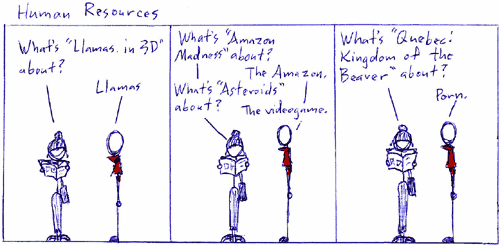
More Human Resources

Issue 149, for the week of 12/5/2004.

Toast Note: Presenting “Human Resources” comic strips 12-25. (Click here for Strips 1-11, in issue 145.) Medium: Blue ballpoint pen (museum issue) and red magic marker (museum issue) on recycled note pad paper (museum issue), improvised straight edges (museum/personal issue). Dedicated to the wage slaves of America, and the founder of the feast, Curious George.

Updated: Click here for Strips 1-11, in issue 145. Click here for Strips 26-41, in issue 158.

Letter to the Editor

Issue 147, for the week of 10/24/2004

From the Boston Metro Weekend Edition, Oct. 22-24, 2004, page 29:

“NEW PAD ON NEWBURY”

WHEN CHRISTINA Capone moved from her digs in New York she had a bit of anxiety about abandoning the hustle and bustle of “the city.” She was ready to head back to her hometown of Boston, but didn’t want to trade off on her urban lifestyle. “I was nervous when I looked at places in Beacon Hill because there was nobody on the streets,” said Capone, 26, who works in the media department at Hill, Holliday, Connors, Cosmopulos Inc. The solution — a modern, two-bedroom, door-man building on Newbury Street. Needless to say, she hasn’t missed a beat. “The constant motion is so important to me,” said Capone, while gazing down from her third-floor apartment at the consistent flow of shoppers passing Niketown and the oh-so-cosmopolitan diners heading into Armani Cafe. The floor-to-ceiling windows in her spacious abode help to absorb the energy of the city’s most fashionable street. The glass coffee table, khaki-colored couch peppered with primary-colored pillows and modern art on the walls pulsate urban sophistication. “The inside reflects the outside and the energy of the city,” she said. Although a posh place on Newbury can be a bit of a drain on your wallet, the convenience makes up for all the cash you’d be dumping into a car, said Capone. “My mentality is that there is no reason to drive. Everything should be in walking distance,” said Capone. Whether it’s a fresh salad from Scuzzi a block away, or a pasta dish from Piattini Wine Cafe across the street, everything is right at your fingertips. And, although Capone admits she does have a weakness for the trendiest purses at Luna, which she stores nicely in her walk-in closet, the rest of the swanky shops don’t tempt her. “I’m lucky that I don’t have a shopping problem,” said Capone.

FACTS: Name: Christina Capone – Age: 26 – Occupation: Media relations at Hill, Holiday, Connors, Cosmopulos Inc. – Rent/Own: Rent – Size: Two-bedroom – Where: Newbury Street

– CHRISTINA WALLACE

Sent to the Boston Metro October 24, 2004:

Thank you for this weekend’s Home section profile of Christina Capone’s “New Pad on Newbury.” Might I, however, submit a somewhat different profile?

After five months of post-college job seeking, animator Matthew Rasmussen, 24, settled into an hourly-wage position selling tickets at a local museum. He now rents (not owns) a room in a four bedroom Inman Square apartment, which features a living room, a porch with peeling paint, and a mostly-functional kitchen. Rasmussen’s bedroom is tastefully appointed with a desk of his own construction, an oak futon, and a prefab bookshelf. A geranium by the window, perched jauntily atop a milkcrate, quietly pulsates urban sophistication when it needs to be watered.

Reader Lindsay LeClair adds:

Lindsay B. LeClair lives in an apartment with floors so uneven that even the

shelves are falling over, but it’s otherwise cozy and sunny, with a kitchen to

beat the band. She is cohabiting with her boyfriend of nearly five years,

which is terribly convenient — she would not be able to afford living in

Boston if she didn’t share a bedroom. It’s too bad, really, that this

convenient apartment is nowhere near a grocery store. The young couple was

really counting on Lindsay’s beater car to make up for that. All jokes aside,

the apartment is beautiful, convenient to the T barring, if convenience

includes strolling through an industrial, lifeless bioengineering square where

you’re pretty sure they’re actually TRYING to make the undead… or at least

that’s what it smells like. In spite of all that, Lindsay is very happy in

their new apartment.