Pull your London trenchcoat up Think of 1950-something Think of all the decades they erased And the newsreel says The less you know, the better The less you know, the better You touched her face And now you’re racing to forget her -Comaduster
“There are people that don’t fit in anywhere, Mr. Cribben. Did you ever think about that? I mean, they won’t live by your ways and mine. Some of them are too good, and some are too bad. Everybody’s growing pretty much alike—nearly everybody—in this age, and the ones that don’t fit in are scarce; but they’re still around.” -Russell Kirk, “Behind the Stumps”
1
The farmhouse beguiled Keel, riding the limit of his vision upon the distant hillside. It appeared as a ramble of joined-up houses and outbuildings predating the two ephemeral centuries his life had touched. A stand of trees fettered the largest mass, presumably a barn, at one end. The walls were lime white, the roofs orange tile in two shades that didn’t quite agree, like the rooflines. If the tiny, inset windows ever caught the sun, he’d never witnessed it. Maybe there were no longer any window. He was fairly sure he could find the way on his touring bike if he could find the time, but Keel’s time was not his own.
He had a baby now. It was what he’d pined after for so many years, and now it was his, or he its. Only the rocking, crunching flight of the baby carriage–the barnevogn, an expat needed to learn the language–could make the baby sleep. The long walks, at every hour of the day and night, were in a way the freest he ever felt now. The baby came first, second, last, always. This was as it should be, but Keel couldn’t always shake his self-pity, despite the long-ingrained knowledge (his was a late start for a new father) that self-pity is self-abuse.
What of the baby? He was pretty. Not girl or boy pretty, but something entirely its own. Impossibly pretty. Changeling pretty. Somehow he’d never before perceived how variably unnatural babies looked. One neighbor’s child had a face like the rancor. Another’s resembled a grey. Pointed ears, pointed chins, pointed butts… The twins were impossible to describe beyond their rosy cheeks and laughing eyes. Surely the other parents couldn’t properly see what they were pushing in their barnevogner.
The baby gave up his fight with the covers and slept.
Keel turned for home–or the apartment, at any rate. Home was far south in another country. In another sense, home was nowhere, not for years. By the narrowest definition, home was a citadel of new three-story concrete buildings dressed with pre-aged wood (all badly, but each differently) upon an isolated hilltop. Two 19th Century stone barns remained nearby, grand in their partial ruin, girded by chainlink fences. A weathered white brick church marked a waypoint across the big road, surrounded by the bones of a rain-lichened village, barely inhabited if at all. Christmas lights twinkled there throughout the night, but something about their uniformity suggested the contrivance of a town council, developers, or someone else. Seemingly everyone lived in the new developments, which had expanded like a fairy ring until running out of forage in the rocky ground. He knew every way and shortcut by now, every path that could accommodate the barnevogn. The city wasn’t far away, by colloquial reckoning, but it might as well have been in another land.
Flashing its white stripes and blue-black trim in the morning light, a magpie–husskade, he was learning the local names–hopped from branch to bare branch, watching him like an hourly supervisor. Saint Lucia’s day was past. Frosted grass crunched under the wheels.
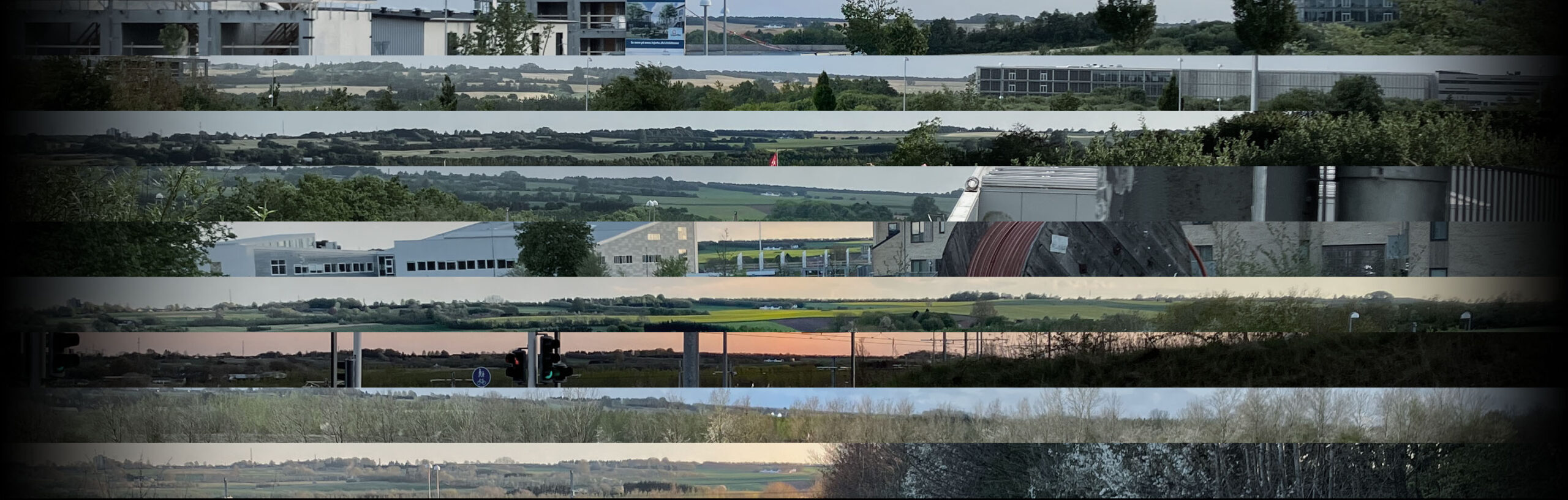
A meandering fox-run cut through the field, visible now that the hay was cut. Wind-battered chestnut trees clung together in the sandy soil. A stream refused to be diverted by an earthwork, forming a meter square swamp before disappearing into the hill for a stretch and sneaking under the road. Keel’s feel for the dynamism of the landscape kept him engaged through the fatigue. It was something he could neither disentangle himself from nor properly share. He knew it as an inseparable part of him, which suggested a nobility where others found only tedium.
Other displaced fathers pushed carriages along the paths, most lost in the glamour of their phones.
The farmhouse dazzled white and yellow in the frosted distance. Was it inhabited? Empty? A ghost? If a ghost were something impossible to understand, what was a thing impossible to notice? The magpie’s shadow flitted over him.
“Its malevolent gravity drags humanity and all human ideas into its orbit, warping them beyond recognition. Beneath it, within its context, everything becomes corrupted into the worst version of itself. It takes joy and turns it into vindictive glee; it takes self-reliance and turns it into solipsistic psychosis; it turns love into smothering assault, pride into humiliation, families into traps, safety into paranoia, peace into discontent. It turns people into people who do not see people as people. And civilisations, ultimately, into abominations.”
-Sam Hughes, There is No Antimemetics Division
This is the moment when Hughes’ novel, I think, reaches beyond high-concept pastiche to truly touch something great. An idea, a meme, so all-encompassing that it doesn’t merely pervade and rot everything it casts its dark light on, but replaces the whole with a new always-was.
My son is a year and a half old. I’m 45. I’m a different generation than most of my peer-dads. My memetic space is different. My inevitabilities are different.
The technology now exists to “watch” Hugin everywhere he goes. To know everything he reads, watches, plays, experiences. Because WHAT IF THE WORST HAPPENED? Knowing I could have reached for that golden bough, had the knowledge to prevent the worst–and didn’t. What would that make me?
Hugin scraped his knee so it bled, and got a real prize shiner on his forehead, all today. Since daycare. In my care. My philosophy is: cool, good. You should see him climb! He’s an explorer. He’s a mover. He’s a ponderer. He’s a sweet guy. And he’s going to have worse.
We wandered dumbly into surveillance capitalism. A pack of lies from marketing scum sold the world its panopticons: It’s free because your privacy is worth nothing! Simultaneously: With enough data, we can sell people anything! It wasn’t true in either direction. But if we’ve learned anything from Trumpism, it’s that true is a far more fragile and optional meme than a refugee from the 20th Century would have assumed. Easy is a meme. Everyone else does is a meme. I’m busy is a meme. Stressed. I can do this. I can get out of this hole. I just need a little space. There are so many memes louder than true. Surveillance is a legitimate business. That’s a meme.
Like every child, Hugin stands where a torrent of historical winds cross.
I will protect him. I must protect him. To both statements, sometimes yes, but primarily I must raise him.
Previous generations weren’t as free as we assume. Yes, as a child in the 1950s-60s, my mother could go several streets in any direction with her friends, but everywhere was a loose network of housewives and old ladies who knew one another, had their phone numbers handwritten in the back of one-another’s white pages, and kept a keen eye on everyone’s children throughout the day. (My dad, in a much smaller town: Fewer checkpoints, larger geography, same vague system.) My parents always needed to know whose house I was at, in the 1980s-90s (though it helped that they needed to drive me there until 1996).
The difference in the 2020s is twofold.
First, the granularity has increased extraordinarily. My parents couldn’t even see what I checked out from the school library. Parental controls will literally show me everything Hugin examines. The power is heady. The power is corrupting. The power tries to keep a straight face as it smirks, “What if?” That infrastructure wasn’t built for the benefit of my son; it was built for the massive collection and collation of his thoughts. Initially, to sell him things. Now, to shape those thoughts. Have I mentioned that surveillance capitalism is now politics?
The second difference is, in fact, worse. The second difference is internalization. The meme is no longer a meme, it is the whole memetic space. Have you noticed you can now tell the age of someone online by the circumlocutions they use to allude, even vaguely, to anything serious? Suicide, rape, death, sex. Everything is autocorrected away before it even gets from Millennial/Gen Alpha fingers into the device. They are so used to being watched in every space in which they can communicate, at least by a lazy bot, that they self-censor as a reflex, like Soviet peons. (I fear it’s even deeper. I see suggestions that the surveillance-native feels that their inner thoughts are public. The sleepless imperfections of the new parent are pathologized. The schoolgirl crush on a teacher is pathologized. The teenage boy wanting to see nudity is pathologized. Every inner rebellion must be quelled. God I hope I’m wrong.)
This is where ChatGPT would start talking solutions. ChatGPT can fuck off. Free Range Kids has failed as badly as the Sceptics Movement. I don’t know (unintentional Howard Beale voice) what to do. I don’t know what I must do. I only know that we need to name this abomination, give it metaphysical form, before we can manage it. We need to see the meme for what it is: Another flimsy spinning thing of money, monomania and anxiety, demanding to be treated as inevitable, re-internalized, and forgotten.
We need to accept the memetic version of those skinned knees and bonked heads. We need to do better in our own framing of the problems our children face. Giving in to anxiety is just… so… easy now. Dress it up as righteousness, and you never have to think about it again. Perfect.
Or we can parent these amazing kids the hard way. Whatever the fuck that is.
Picture a board book, with a round hole through the center. The hole grows smaller with each page, missing entirely on the last.
Page 1. Vague interior with “wallpaper” that looks like a cute diaper pattern. A painting is literally Photoshopped in. The hole IS the main character:
There once was a little butthole, who lived in a snug little home. It was warm, soft and carpeted. He even a Vermeer painting. (So I’m told. I’m pretty sure that’s a Cassatt.)
Page 2. The butthole tosses his Trilby hat onto the coatrack:
The butthole had a nice life. He did some work, usually every day, sometimes less, sometimes more. The work was boring, but it needed to be done.
Page 3. Buckets & flower pots are out catching leaks, but it’s not interruping his evening on the barcalounger:
True, sometimes his house would get a bit wet. But, into every life some rain must fall. He didn’t usually mind.
Page 4. He’s tiredly thrown the trilby, and missed the rack. The pots are in disarray. The Cassatt is crooked:
Usually. There came a time when the work got too much. No sooner did one job end when he’d be needed for another. And another. And another.
Page 5. Flooded! He’s in a rowboat, with his coatrack and his soaked Cassatt. The trilby floats:
Worse, his home was CONSTANTLY flooded!

He started to get tired. He started to get sore. He started to get angry. Pretty soon he was angry, and sore, and tired, and...
Page 6. Big radiating anger lines, on a page of solid:
RED!

There was only one thing to do. Nothing else could make the butthole happy again. He needed to leave his snug little home. He needed to go out into the big, windy world. He needed...
Page 7: Two page spread of a gorgeous, sunny landscape, bursting with color. A couple of chubby back legs and heels are visible below:
Naked Time!
Page 8: Art gallery, with a Vermeer and a Cassatt in background. Midground, the bottom 2/3 of a woman, turning around startled. Foreground, the backside of a man, his unseen butthole where the tiny hole on the previous page would have been:
This story, from my own butthole, happened a long time ago. As we all know, every butthole has a story to tell. Often quite loudly.