Gawker Steals My HR Comic

How sarcastically flattering.

Here is Gawker’s featured shirt of the day:

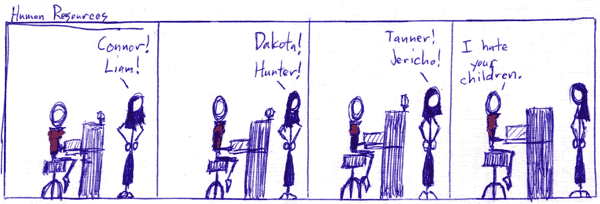
And here is the very first Human Resources comic strip, number 1 of 41, from September 2004:

Here’s how it works. The HR comics were popular with my fellow grunts at the job that inspired them, and were widely circulated on MySpace. (They still get a few dozen hits a month.) Someone saw the strip, liked the punchline, and submitted it to Gawker. They couldn’t spell children.

I guess I should be a little flattered that it was voted highly enough to get a shirt made.

But at least when design firm Pylit liked my Tape Case Bike Light, they were decent enough to pay me to rewrite the article for them.

You Can Put a Pig in a Dress, Too

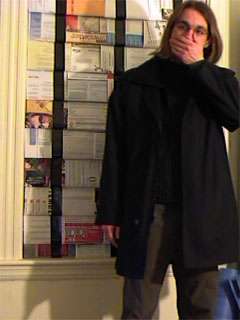
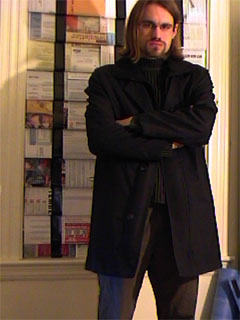
This weekend, as part of my ongoing project of pretending to be my age, I picked up my first decent coat in Freeport, Maine.

Now to do something about everything else. This could take a while. Maybe I’ll start with the hair.

It’s a Record

My roommates have gone through an entire roll of toilet paper in one day. Ladies, if any of you are looking for a nice young man to settle down and, I dunno, move in with… let me know.

“Windy City” Enters Its First Screenwriting Competition

My first feature screenplay, “Windy City,” has been entered into the 2007 ASA International Screenplay Competition. The quarterfinalists will be announced by February 28, 2008, with the semifinalists coming out April 30 and the final winners being announced at the awards ceremony at the end of September, 2008.

As much as I dread (and typically fail) at self-promotion, it’s nice to be back on the contest scene. Æsop’s Council of Mice was my last animated film to play the film festival circuit, following the relative success of my award-winning debut Marboxian. Owing mainly to financial difficulties, I wasn’t able to do much with Mice, and I’ve had to focus on making a living since.

It’s been mentioned a few times here, but maybe it’s time to introduce the thing. Windy City is a classic city mouse/country mouse story written by someone who’s been both. It has airships and fantastic cities, natural and manmade disasters, and a whole laundry list of other exciting things. But that’s not why you’ll fall in love with it. The real movie is about a boy from the valley and a senator’s daughter from the city — Dan Assurbani and Nineve Sherrib — and how their lives meet and grow more and more complicated.

Windy City started life as a treatment six or seven years ago. At about this time last year, I dusted it off and set about cleaning it up. Somehow the treatment became a full first draft by April, and I had some friends with a bit of theatre experience over to do a cold readthrough. I sat on the lessons I learned from hearing it out loud, and the remaining issues I had with it, picked at it for the next few months as life got complicated again, and finally — in four days at a friend’s house in coastal Maine — burned through to a second draft in late August.

It’s been an interesting year. Wish Windy City luck.

A Different Hill

In my dreams there’s another Boston.

Where the Fenway and the E train should be there’s an expanse of rundown, uninteresting concrete buildings. Maybe there’s another line south of the E train.

Last night, after the flat concrete section came a neighborhood of steep hills with equally rundown platforms, roughly where Roxbury should have begun.

To the west, where Brookline should have been — or at least the no man’s land between the D train and Coolidge Corner — was a shabby, Allston-like, busy Y-shaped intersection. There was a place I needed to go which was on the far side, behind the intersection, and hard to reach.

To its west, the ground sloped steadily upward for a mile or more. At the top (very high up), looking down over the city, was an abandoned set of concentric concrete terraces, enormous, an expanse of disused parking around a building that wasn’t used anymore. Sumac and other fast-growing trees were taking hold heavily on the slope.

One night, there was a posh place above MassArt. The street sloped gently upward and broke at a compact building with a glass foyer. The main street curved to the right there. Another, smaller street broke off just before the curve, behind a wedge of brick brownstones, and continued up the same hill; it was much more neglected, and seemed to be where people lived. Maybe that hill was the same as the first. Maybe they were all the same hill.