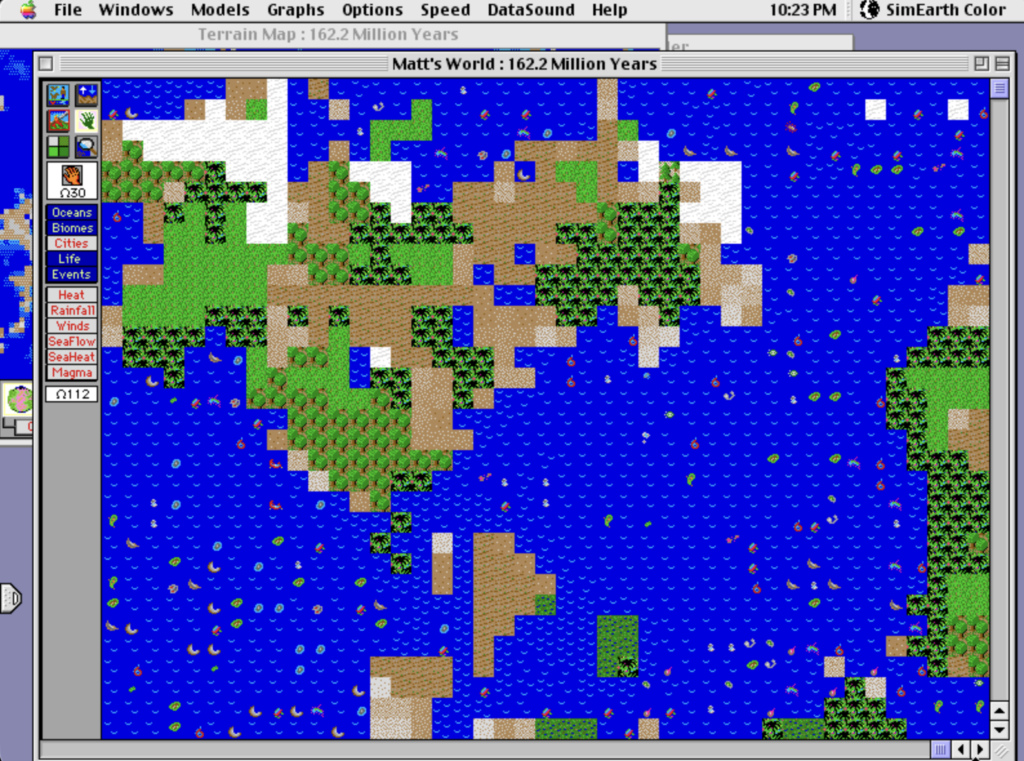
SimEarth was $70 USD when it dropped in 1990. That’s $180 in 2026 dollars. It was Maxis’s third release. Fortunately, their second had been SimCity. The marketing didn’t even call their applications games, but “software toys.” It was a radically different industry back then. SimEarth was not a major hit, but it’s a reminder that, prior to their long death milking the Sims franchise for EA, there was genuine experimentation at Macintosh-first developer Maxis.
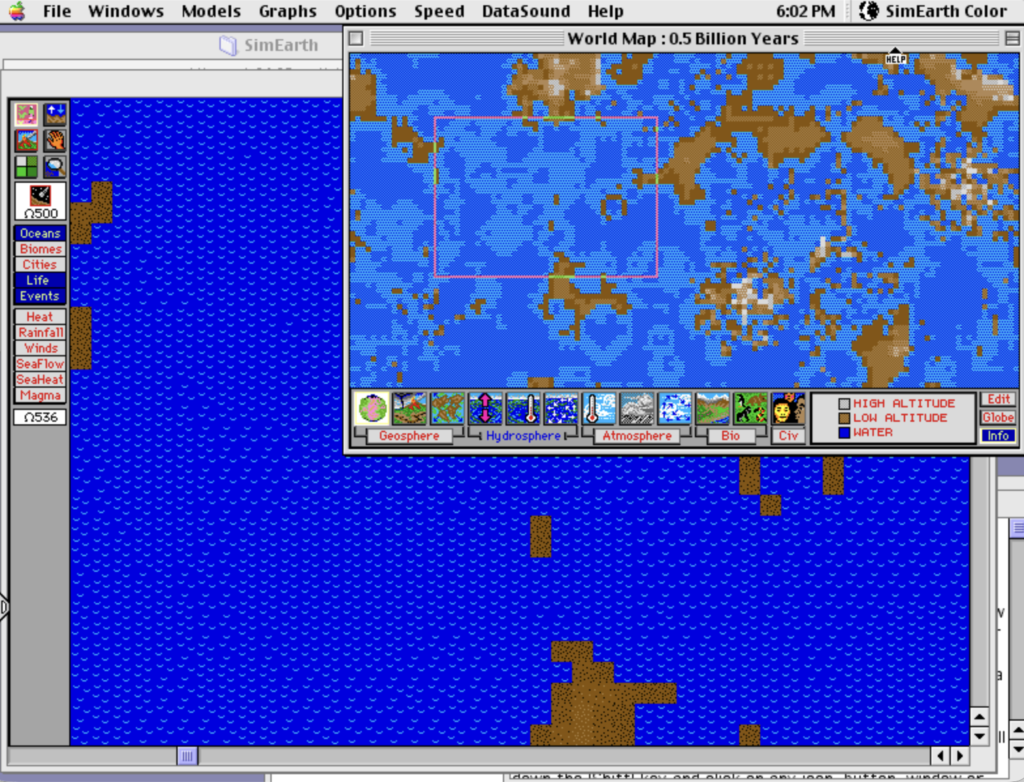
Is SimEarth really a game? Unlike SimCity, you can dial up a random planet and just leave it running. Maybe life will start but get nowhere. Maybe the biosphere will self-destruct, a Venus or a Mars. Or maybe it’ll all go rather Earth-wise with no intervention on your part. (You could even get multiple sentient species developing and blasting off to greener planets, one after the other.) The following year, Maxis would make the metaphor explicit with a virtual ant farm, but in the Danish language sense, SimEarth is lege rather than spil–undirected fun, not goal-based play. In modern parlance, it’s a sandbox.
SimCity famously fits on six pages of readable diagrams, but SimEarth is a geosphere simulation sitting underneath a hydrosphere simulation under an atmosphere simulation, proceeding (with luck or skill) to overlay a flora simulation, fauna simulation, and civilization simulation. It’s dizzying, even if the underlying machinery is essentially the same: Time-sliced agent calculations across multiple interacting tilemaps, with the precision allowed to drop at higher game speeds. Remember, the target platforms for these games were Motorola 68k Macintoshes and 386 DOS PCs.
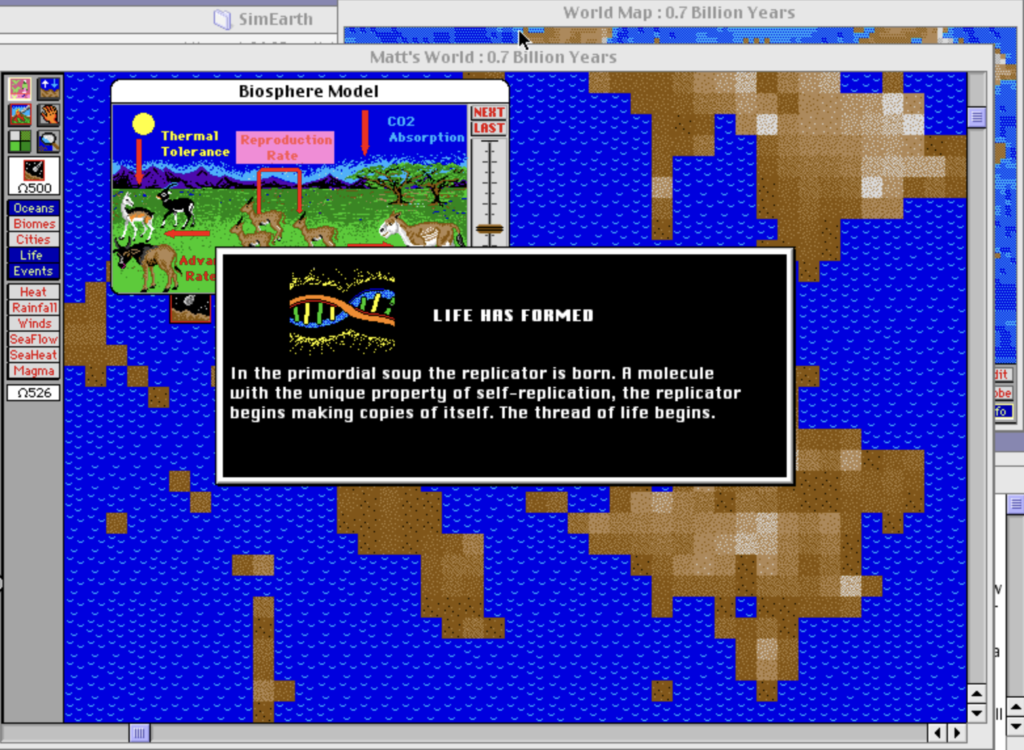
Play (lege) involves a slowly recharging energy counter, capped lower at increased difficulties. The surface can be raised and lowered. “Disasters” like meteor strikes (often beneficial if used right) can be called down. Biomes can be painted on the land (without being guaranteed to survive). The models can be tweaked, for instance to change solar input or reproduction rates. At the more expensive end, there are scifi geoengineering buildings–even an extremely expensive Monolith, for uplifting species to sentience.
Should you play it? You’re reading a blog in or after 2026, so maybe. Maybe you have the patience. (Not that a planet takes more than an couple hours without extreme micromanagement.) It runs perfectly in SheepShaver, so don’t expect problems in the emulator of your choice.
True randomness means that, sometimes, your world is just plain boring. Nothing is inherently fair. It’s refreshing, in an icy way, compared to our era of silent rubber-banding and 50% chances meaning 65% chances.
The interface is of its time. It tries a lot. Most of it works. Window management can feel a bit cumbersome. Just finding where on the map an event has occurred can be downright annoying.
The choices it makes will give any science nerd a few eye twitches. For instance, here’s the list of taxa:
- Prokaryotes
- Eucaryotes
- Radiata
- Anthropods
- Mollusks
- Fish
- Cetaceans (?)
- Trichordates (!!!)
- Insects
- Amphibians
- Reptiles
- Dinosaurs
- Avians
- Mammals
- Carniferns (hidden)
- Robots (hidden)
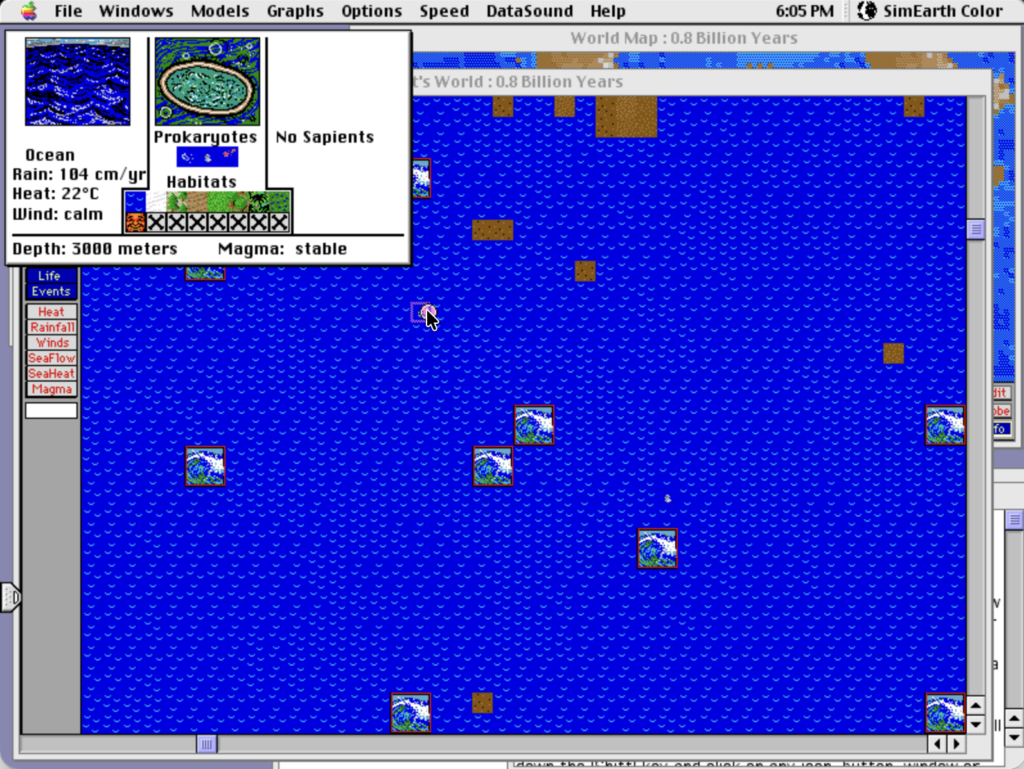
There was no real way to make a comprehensible graphical game in SimEarth’s day without the choices of life and paths of civilization being very Earth-like. They more or less did it with Spore, but that was decades later. (MicroProse’s Civilization itself, released the following year, would have the same issue.) Within its limitations, the amount of weird packed into SimEarth is worth celebrating, but those limitations are omnipresent. When life really gets going, you’ll start to wish for a decidedly bigger world than the target systems of the day could simulate in realtime.
As a middle-aged game developer, it’s the naive boldness of SimEarth that I admire most. As a nerdy tween with a Mac Plus, the appeal is harder to define. I’m sure I didn’t play it as much as SimCity (v1.0) but I sure sunk a LOT of hours in. So many planets lived and died in that cold corner of the living room. Maybe the lack of hand-holding is more appealing at that age. (Doesn’t Minecraft have a similar demographic?) Maybe experimental Earth Science is the best kind to learn. Maybe I just had more time than I could ever know what to do with. There’s value in being bored.
In a few months, my team at Chop Chop drops the full release of Flask, and either starts working on new content, or goes on the dole. No one knows which. I’ve got a little kid, and we’re trying to buy a house. It’s scary. I keep wondering what would have happened if SimCity had done the kind of business SimEarth did. Maxis’s headcount can’t have been much different from ours. At $180 a disk, was a minor success enough to keep the lights on back then? How long could a game software toy development team survive without a hit in 1990? Has it changed? Most importantly, what would games look like now without the era of SimEverything?
Maxis did so much right until they didn’t. SimCity to Spore was 29 years. Both were bold, unique, and successful. Inbetween, and after SimEarth, they played things a bit safer. (Maxis even tried corporate training.) Ironically, it was the slipshod launch of a new SimCity (2014) that ultimately did them in.
For those who were there, SimEarth feels like a blast of Earth Day 1990 optimism. For anyone who grew up afterward, I’m curious. Too slow? Too obtuse? Too klunky? Or is there still an odd pleasure in mastering such a weird, geeky, cool beast?
Maybe in ten years I’ll get my little guy to try it.