New Robert Aickman Anthology Coming in 2018

New York Review Books has announced Compulsory Games, a new collection of Robert Aickman stories scheduled for May 8, 2018. The publisher has separately leaked its table of contents, and its a revelation of hard to obtain material. I’ve updated my table of Aickman’s published works to include Compulsory Games (as well as a very limited 2015 Tartarus anthology).

View the PDF (153k)

Robert Aickman (1914-1981) was the most significant horror writer since H. P. Lovecraft. I can say that with certainty. As an epithet, he was the Last Symbolist (though Fritz Leiber’s “Weatherman of the Subconscious” is also fitting). Beyond that, I can’t tell you much, despite having spent the last two years reading and rereading as much of his work as practical. Leiber admired him, but didn’t understand him. Peter Straub admires him, but doesn’t understand him. Neil Gaiman admires him, but doesn’t understand him. This is not criticism, but praise. Perhaps a ghost is that which you can’t understand.

The Most Generic iOS Games That Don’t Exist (Yet!)

Some call it originality. I call it being the first loser.

The iOS gaming space is crowded. Metacritic lists 10,934. Doing a word frequency analysis on their titles, we can come up with the ultimate must-hit games. I’m expecting a 20% cut when these become reality, on top of whatever Apple’s charging.

War Game Man — It is only a game, isn’t it? Man?

These are the first three nouns on our list. In order. War (349), Game (332), and Man (308), have almost a thousand hits between them, when you exclude two-letter combinations and common hyphen-ation frag-ments. More importantly, they’re three things hardcore gamers crave: Wars, games and men. So I’m told. Felch out literally anything with a tank, a guy in a helmet, and this title, and sit back until you hear the backup beep of the money truck.

Ace Ball Age: Bat Hero — The fate of Baseballalandia teeters on the edge, in this exciting sports/RPG hybrid!

Next up–still in order, without skipping any words–is a guaranteed money spigot. Ace (246) Ball (212) Age (210) Bat (207) Hero (198). “Oh gee, we don’t have any assets for a baseball title or an RPG,” SAID NO ONE EVER! You’ll launch the project Tuesday and be on the app store by Friday. Buy some Sponsored Content (“This Baseball RPG Will Make You Blot Out the Sun With Jizz–Especially If You’re a Woman!”) and start looking like a hoarder’s house but with money stacks.

Tar/Ash Ant Art — Navigate your half-poisoned ants through a ruined canvas factory–then sell your canvases on the fickle, tasteless modern art speculation market!

Sure, Tar (198) Ash (197) Ant (193) Art (188) is probably 90% pieces of other words, but it’s also in order, and also (while a little dark) the sort of strange-sounding, boring-to-play game that smartphone gamers love to hype. Start the train early, with forum posts, concept art, and “first looks.” Maybe put out an unplayable alpha to presale backers (basically the game with a broken start button), an almost-playable beta (a working start button, no levels, and a “crash app after 80 seconds” timer), and finally–finally–the big release (the alpha, with a better splash screen). Go Free to Play after three months. Charge $10 to stop the app from filling your Notification Center with achievement trophies and dead ants.

Maybe not a sure hit now, but they’ll clamor for a VR remake in 12 years.

You want longer words? How about this:

King Venture Adventure — The game that we reskinned with baseball assets to make Ace Ball Age: Bat Hero.

Two for one! King (187) doesn’t even come up in that many other words, and while Venture (184) technically is included in every instance of Adventure (179), they’re still the next three nouns on our list–and still in order, with no gaps. Adventure ho, Your Majesty! Ho I say!

Don’t want to use any more three-letter words at all? Fine. We can still play:

Star Zombie — Star. Zombie. It was on the tip of everyone’s tongue. We just gave it a name.

You got chocolate in my edible body paint, peanut! Star (177) Zombie (170) finally brings together two things the market isn’t at all sick of: Zombies, zombies, zombies, and games with vague generic sci-fi backdrops. Oh no please. Keep some of your money. I have so much…

Battle World: Super Land — Only one can dominate something, somewhere. Presumably!

They said it couldn’t be done in an iPhone game, but we made a game about war! And we made it with the next few words, in order, with no gaps. In Battle (165) World (152) Super (149) Land (147) you decide how to wage peace across the ill-fitting board, in the only game to include square, hexagonal, pentagonal, and rhomboid tiles in the same otherwise largely undifferentiated levels.

Aw hell, just give me $1MM now and I’ll throw in the next 21 (in-order, four or more letter, without gaps, guaranteed hit titles) for 10% off the top:

Word Puzzle Monster — (146, 139, 133) More puzzles! More monsters! Less attention span! HEYYY-AAAH!

Space Quest: Drag Night — (128, 123, 116, 113) Not all space heroes wear capes, but when they do, they’re velour.

Dragon Cape — (108, 104) Not all dragons wear velour, but…

Edition Edit — (97, 97) It’s 1933. You’re William Allan Neilson and Thomas A. Knott. Can you finish the Webster’s New International Dictionary?

Dead Escape Time: Episode Legend — (95, 94, 90, 88, 88) Not only is this probably edgy in some way, but say “episode” and your DLC levels become full-priced sequels.

Last Rush Defense — (87, 87, 80) Tower defense has never been this towery, or defensive!

Fight Racing: Tiny Story (Mini) — (80, 78, 77, 74, 74) Kart man, do!

Dark Jump — (74, 74) You’ll fall. A lot. The paincore hit of the month of Maying.

Light Race Soccer — (68, 68, 68) All Soccer Players Matter.

Pocket Craft Fish — (67, 63, 62) Maybe crafting has nothing to do with fishing, but maybe shut the hell up.

Rock Rain Tale — (61, 61, 61) “Sit here by the fire, promising indigenous youth, and I’ll tell you the tale of the day the rocks rained down…”

Dash Knight Ventures — (61, 60, 58) Sadly, nostalgia-buying an even worse knockoff of Rocket Knight Adventures probably won’t be the worst life decision your customers will have made.

Little Plan: Lost Robot Adventures — (58, 58, 58, 58, 57) So cute it won’t matter that the game is 90% walking across different backdrops.

Kingdom Port — (56, 56) Build your… port! In the kingdom! Kingdom Port!

Fantasy Magic: Kill Less — (55, 55, 55, 54) Really, you’ve been going a bit mad with power lately. We’re all concerned about you.

Part — (54) Spread things and stick other things into places in this puzzling–and completely non-erotic–puzzle game.

Ever Fall — (54, 54) Messianic sci-fi, surreal action puzzler, or primetime WB drama? Yes!

Block Tower Island — (53, 53, 51) The sequel to Last Rush Defense! Virtually indistinguishable.

Bird Ride: Blast Legends — (51, 51, 51, 50) I’ll give you something to be angry about.

Road Shoot — (50, 50) Finally! Mayhem involving roads.

Sword Pixel Runner: Monsters Down! — (50, 50, 50, 49, 49) Save the things from the other things, in the ultimate pulse-pounding ironic hipster 8-bit whatever.

Make cheques payable to the management.

Board Game: Fair Verona (v0.1)

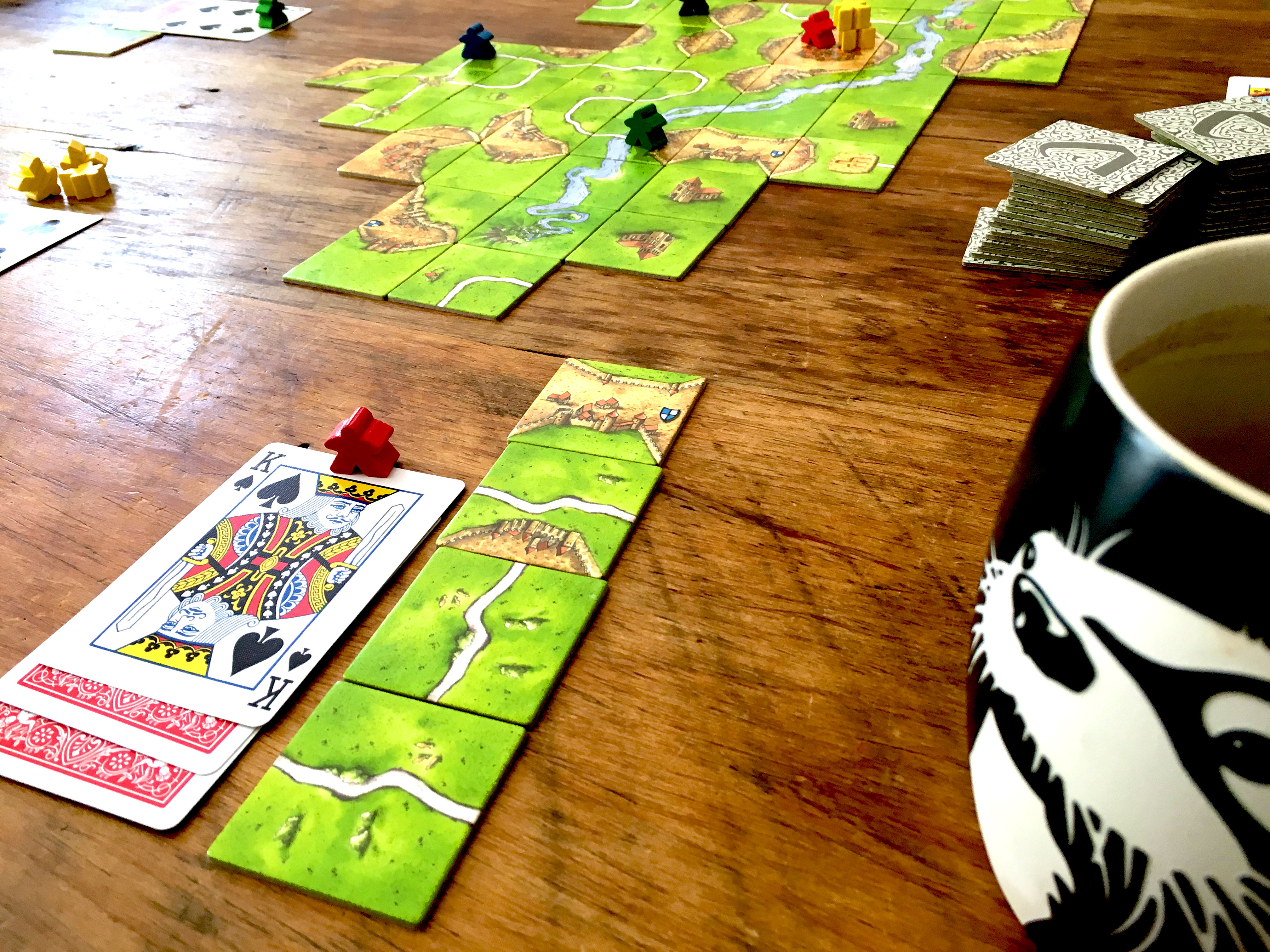
If you have a chess board, you can play chess or checkers. If you have a deck of cards, you can play any number of games. But if you have a Carcassonne set, you can only play Carcassonne. As every modern geek has one, I thought we needed another game to play with it.

You play the aunts and uncles of the polymath Verona in the dangerous and romantic city states of classical Italy. Verona is brilliant, scatter-brained, obsessive, creative, charming, a magnet for trouble–and all of 17 years old. Having promised her dearly-departed parents to look after her, it’s up to you to do the legwork of the latest mystery she’s stumbled upon.

Objective

Four players cooperate to build a board of Carcassonne tiles while trying to locate and return Clue Tokens to the starting tile. Card value based Encounters hinder you and advance the game.

You Will Need

  • A Carcassonne Game (including the standard River expansion)
  • A standard deck of playing cards

Setup

Shuffle the deck of cards, including the two jokers. Find the “all city” Carcassonne tile–the Old Town, where Verona lives–and place it in the center of your play surface. Deal each player an Identity card face up. Each player selects a meeple color, placing one of that color on the starting tile, and one on their Identity card. Deal one additional card–the Clue Card–face-up beside the deck, and put a meeple of the unused color atop it as a Clue Token. Randomize the remainder of the normal Carcassonne tiles and set them aside. Randomize the River tiles, and prepare to start with them.

  • Easy Game: Put out 5 more Clue Tokens, for a total of 6. Deal each player 2 more cards, sight-unseen, to be placed beneath their Identity Card–these are their first two Friend cards. (Explained below.)
  • Medium Game: Put out 6 more Clue Tokens, for a total of 7. Deal each player 1 Friend card.
  • Hard Game: Put out 7 more Clue Tokens, for a total of 8. Deal no starting Friend cards.

The Identity Card

Each card in play represents a unique person. Your Identity card is your player character. The face value represents a person’s role in the social hierarchy, from the cutpurse and con artist (2-3) through the city leaders and geniuses (J, Q, K, A).

Card suits represent specialties:

  • Spades: Alchemy, painting, invention, dance, poetry.
  • Clubs: The sword, the lance, the grapple, the fist.
  • Diamonds: Gold, debt, silver, ships at sea.
  • Hearts: Love, family, desire, comradery.

Play

Play proceeds clockwise from the dealer. Each turn has three phases:

  1. Tile Placement
  2. Encounter Clearing
  3. Movement

Tile Placement

At the beginning of a turn, the player always attempts to place a tile–either a face down tile, or an unplayed (face-up) tile. Tile placement rules are identical to normal Carcassonne (including the need to start with the River tiles) except for one major change: A tile must be placed on a space adjacent to the one your meeple currently occupies, horizontally, vertically, or along a diagonal.

If you place a tile with a shield (pennant), or complete a city, you have made a Friend. Draw a card from the deck and place it beneath your Identity card, sight-unseen. (Note that you don’t make a Friend from drawing a shield tile, only from playing it!)

If a tile can be played, it must be. You may not select a face-up tile that can not be played, but nothing requires you to select a playable tile if face-down tiles remain.

If a tile can not be played, it is placed face-up beside your Identity card, and an Encounter is triggered for the next player: Draw a card from the deck and hand it to the next player.


Encounters

Danger and intrigue are ever present! Clearing Encounters is the second phase of a turn. When dealt an Encounter card, place it above your Identity card. You may not move until all your Encounters have been cleared. If you are on the same tile as a player with an Encounter card, you may help clear one of theirs. You clear an Encounter by bringing to bear a higher total value than the Encounter card itself.

You determine your total strength (value) in an Encounter as follows:

  • Your Identity card’s face value
    • Plus or minus any Distance Bonus
    • Times any Suit Multiplier
  • Plus any other player on the same tile’s face value
    • Plus or minus any Distance Bonus of theirs
    • Times any Suit Multiplier of theirs
  • Plus the face value of a Friend card, if you choose to play one
Distance Bonus

The wealthy and famous are at their strongest in the Old Town, while the lower classes are better out in the hinterlands. To find your Distance Bonus, count your current distance from Verona, either horizontally or vertically (whichever is greater).

  • Face Cards and Aces: Your value drops by 1 per tile away from Verona. For example:
    • A Queen 3 tiles north [and 1 tile east] of Verona is worth 9.
      • Queen minus 3 = J… 10… 9.
    • An Ace [2 tiles south and] 6 tiles east of Verona is worth 8.
      • Ace minus 6 = K… Q… J… 10… 9… 8.
  • Number Cards: Your value grows by 1 per tile away from Verona beyond your face value–in practice, this means your value is the greater of your face value or your distance from Verona. For example:
    • A Two 7 tiles south [and 6 tiles east] of Verona is worth 7.
    • An Eight [3 tiles south and] 9 tiles east of Verona is worth 9.
    • A Five 2 tiles north [and 1 tile west] of Verona is still worth 5.
Suit Multiplier

Your Identity card’s suit is your specialty. In an Encounter against the same suit, your face value (plus or minus any Distance Bonus) is doubled. For example:

  • A 7♦ can not clear an Encounter with a Q♠.
    • 7 (♦) is not greater than Q (♠).
  • A 10♥ can not clear an Encounter with a 10♣.
    • 10 (♥) is not greater than 10 (♣).
  • A 4♠ can clear an encounter with a 7♠.
    • 4♠ times 2 = 8(♠). 8 (♠) is greater than 7 (♠).
Friends

In an Encounter, you may optionally call on a Friend if you have one available. Turn one of your Friend cards over, and add its value to your Encounter. (Your friend gets no Bonuses or Multipliers). Regardless of whether it helps you clear the Encounter or not, the Friend card is then discarded.

Clues

Some Encounters include a Clue Token, which goes to you after the Encounter is cleared, and must then be returned to Verona.

At the start of the game, the first Clue Card was turned over, and a Clue Token (meeple of the unused color) was placed atop it. The Clue Card is what Verona knows about the person who holds the next piece of the puzzle. She’s never quite right.

When an Encounter is triggered with a Clue Card in play, the suit and value of the Encounter card and Clue Card are compared. If either the suit or face match, the Clue Token becomes the prize of the Encounter. Discard the current Clue Card and move the Clue Token onto the Encounter card. When you clear this Encounter, move the Clue Token onto your Identity Card. Your objective is now to return it to Verona.

Clue Tokens may be handed off from one player to another on the same tile at any time. When the Clue Token is returned to Verona’s tile, stack it atop the others, draw a new Clue Card, and place a Clue Token on it. Having received the clue and figured out what it means, Verona dispatches you to find the next piece of the puzzle. You (and Verona) win the game by collecting all of the Clue Tokens in play.

Cleared Encounters

On clearing an Encounter, discard the Encounter card. If you have no more Encounter cards, you may proceed to the Movement phase. If you still have Encounters uncleared, your turn is over.


Movement

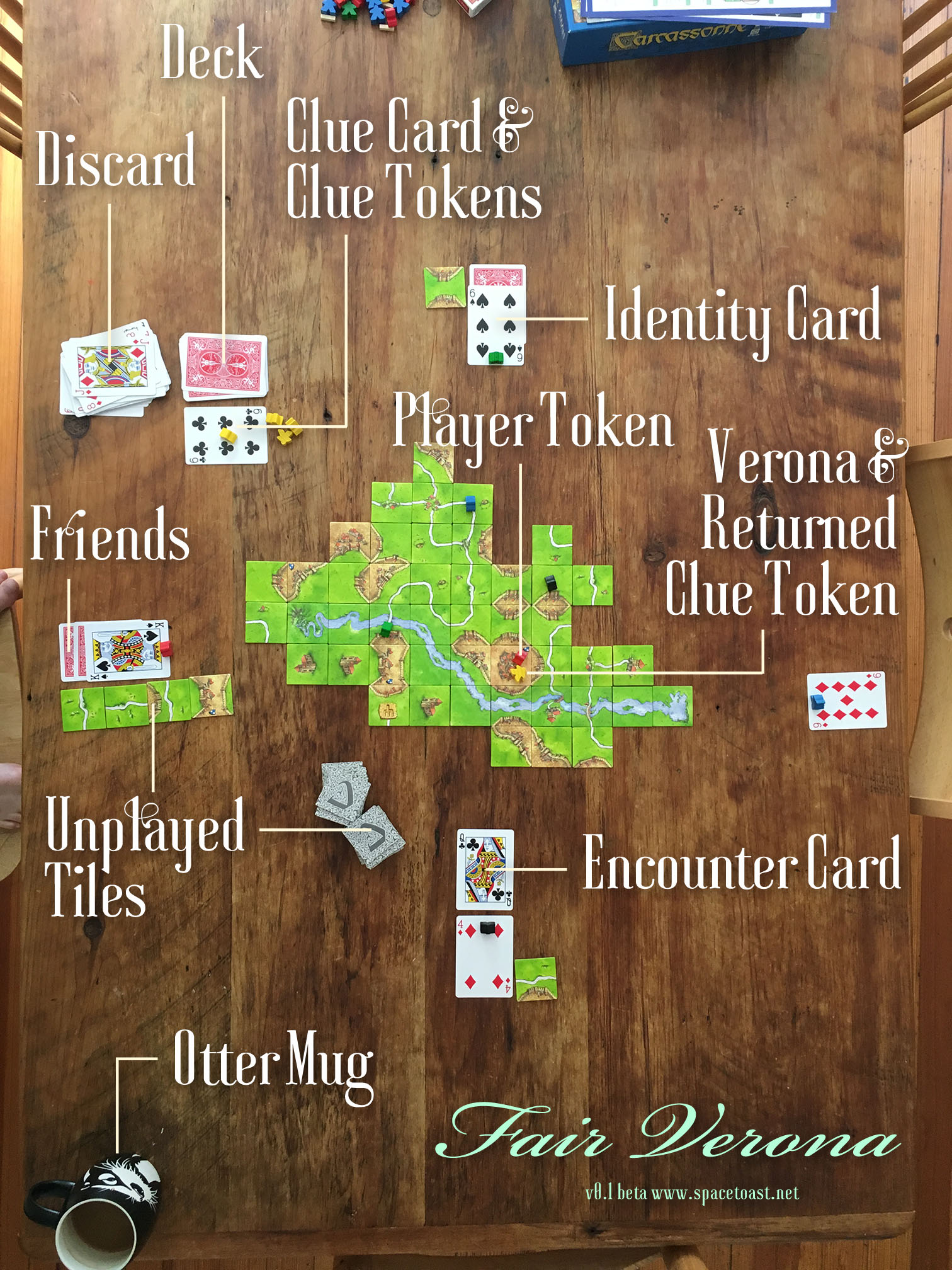
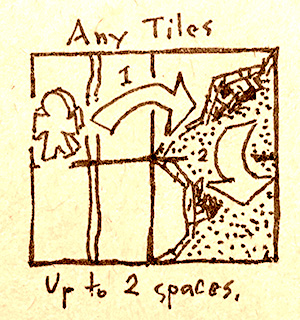
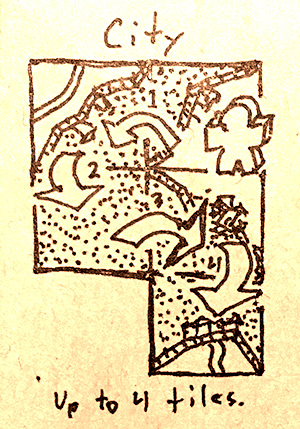
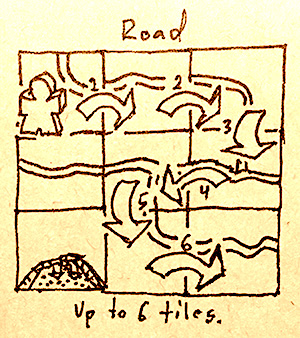
In the third and final phase of a turn, the player may move their meeple from tile to tile (horizontally or vertically) by one of the three methods below. The player may elect to start from any terrain feature (road, city or field) on their starting tile.

  • Any Terrain: Up to 2 Tiles
  • Through City: Up to 4 Tiles
  • Along Road: Up to 6 tiles

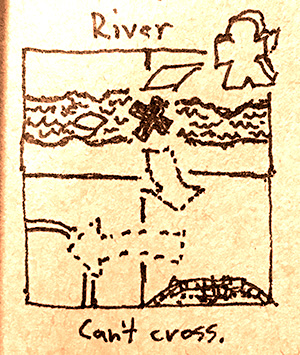
In city or road movement, terrain barriers may not be crossed. Thus, you may not “jump” from one city to another across a stretch of farmland, even if both city walls lie on the same tile. Rivers, likewise, may only be crossed at a bridge or at a River’s beginning or end tile. (Be sure to place your meeple on the correct bank.)


Jokers

If at any time in play a Joker is drawn, all Clue hunting halts. Cover any Clue Card in play with the Joker. Young Verona has fallen head over heels for some flashy young fool, losing track of everything else, and one of the players must return to talk her out of it. The Clue Card is out of play until a player returns to the starting tile, at which point the Joker is discarded, and normal play resumes.

End Game

The conspirators are trying to box you in. Thus you lose if:

  • Every player is mired in an Encounter they can’t clear
    • or
  • Every player has 2 or more unused tiles.

Verona must put together all the pieces of the mystery–with a little help from her family. Thus you win when:

  • You return the final Clue Token to Verona.

Umberto Eco on Fascism

It’s worth now revisiting 1995 when Umberto Eco–child of Italian Fascism–explained to us the 14 hallmarks of fascism, be it Italian, German, Spanish, Russian or otherwise: Ur-Fascism. Here’s a gloss in reverse order; ellipses mine, emphasis his.

14. Ur-Fascism speaks Newspeak… All the Nazi or Fascist schoolbooks made use of an impoverished vocabulary, and an elementary syntax, in order to limit the instruments for complex and critical reasoning. But we must be ready to identify other kinds of Newspeak, even if they take the apparently innocent form of a popular talk show.

13. Ur-Fascism is based upon a selective populism, a qualitative populism, one might say. In a democracy, the citizens have individual rights… For Ur-Fascism, however, individuals as individuals have no rights, and the People is conceived as a quality, a monolithic entity expressing the Common Will… Thus the People is only a theatrical fiction… There is in our future a TV or Internet populism, in which the emotional response of a selected group of citizens can be presented and accepted as the Voice of the People… Wherever a politician casts doubt on the legitimacy of a parliament because it no longer represents the Voice of the People, we can smell Ur-Fascism.

12. Since both permanent war and heroism are difficult games to play, the Ur-Fascist transfers his will to power to sexual matters. This is the origin of machismo (which implies both disdain for women and intolerance and condemnation of nonstandard sexual habits, from chastity to homosexuality). Since even sex is a difficult game to play, the Ur-Fascist hero tends to play with weapons—doing so becomes an ersatz phallic exercise.

11. In such a perspective everybody is educated to become a hero. In every mythology the hero is an exceptional being, but in Ur-Fascist ideology, heroism is the norm. This cult of heroism is strictly linked with the cult of death… The Ur-Fascist hero is impatient to die. In his impatience, he more frequently sends other people to death.

10. Elitism is a typical aspect of any reactionary ideology, insofar as it is fundamentally aristocratic, and aristocratic and militaristic elitism cruelly implies contempt for the weak. Ur-Fascism can only advocate a popular elitism. Every citizen belongs to the best people of the world, the members of the party are the best among the citizens, every citizen can (or ought to) become a member of the party. But there cannot be patricians without plebeians. In fact, the Leader, knowing that his power was not delegated to him democratically but was conquered by force, also knows that his force is based upon the weakness of the masses; they are so weak as to need and deserve a ruler…

9. For Ur-Fascism there is no struggle for life but, rather, life is lived for struggle. Thus pacifism is trafficking with the enemy. It is bad because life is permanent warfare

8. The followers must feel humiliated by the ostentatious wealth and force of their enemies… However, the followers must be convinced that they can overwhelm the enemies. Thus, by a continuous shifting of rhetorical focus, the enemies are at the same time too strong and too weak…

7. To people who feel deprived of a clear social identity, Ur-Fascism says that their only privilege is the most common one, to be born in the same country. This is the origin of nationalism. Besides, the only ones who can provide an identity to the nation are its enemies. Thus at the root of the Ur-Fascist psychology there is the obsession with a plot, possibly an international one. The followers must feel besieged. The easiest way to solve the plot is the appeal to xenophobia…

6. Ur-Fascism derives from individual or social frustration. That is why one of the most typical features of the historical fascism was the appeal to a frustrated middle class, a class suffering from an economic crisis or feelings of political humiliation, and frightened by the pressure of lower social groups…

5. …Ur-Fascism grows up and seeks for consensus by exploiting and exacerbating the natural fear of difference. The first appeal of a fascist or prematurely fascist movement is an appeal against the intruders. Thus Ur-Fascism is racist by definition.

4. No syncretistic faith can withstand analytical criticism. The critical spirit makes distinctions, and to distinguish is a sign of modernism. In modern culture the scientific community praises disagreement as a way to improve knowledge. For Ur-Fascism, disagreement is treason.

3. Irrationalism also depends on the cult of action for action’s sake. Action being beautiful in itself, it must be taken before, or without, any previous reflection. Thinking is a form of emasculation. Therefore culture is suspect insofar as it is identified with critical attitudes. Distrust of the intellectual world has always been a symptom of Ur-Fascism… The official Fascist intellectuals were mainly engaged in attacking modern culture and the liberal intelligentsia for having betrayed traditional values.

2. Traditionalism implies the rejection of modernism. Both Fascists and Nazis worshiped technology, while traditionalist thinkers usually reject it as a negation of traditional spiritual values. However, even though Nazism was proud of its industrial achievements, its praise of modernism was only the surface of an ideology based upon Blood and Earth (Blut und Boden)… The Enlightenment, the Age of Reason, is seen as the beginning of modern depravity. In this sense Ur-Fascism can be defined as irrationalism.

1. The first feature of Ur-Fascism is the cult of tradition… As a consequence, there can be no advancement of learning. Truth has been already spelled out once and for all, and we can only keep interpreting its obscure message….

How to Write a Pretty Darn Good OKCupid Profile

I’m a 30-something, single, straight male with a decent job, the ability to dress myself, some social graces and worldliness, a liking for kids, and the desire to “settle down” and begin the next adventure of my life. This, in theory, means that I’m the sort of man that women in their late 20s to late 30s join dating sites like OKCupid.com to meet.

Yeah, it’s a weird thought for me too.

I’ve been on and off the site for several years, and had several relationships with women I’ve met through it. As such, after helping my roommate with her own profile, I’ve been asked to put together some tips on what we look for–and don’t look for.

It’s Ladies Night on SpaceToast.net.

It’s Only a Marketing Piece

Write enough to distinguish yourself. You’re the product. Give us a reason to remember you. You don’t get to post a three line profile and then complain that guys only write, “Hey girl heeey!” You love [local sports team], [popular band], travel, and your family? Great. Your prince will not be able to read your mind; weren’t you paying attention to Frozen?

Don’t write a novel. Respect your reader’s time and attention. There’s always more to know about you; that’s what chatting and meeting up is for. This is a marketing piece, and not in the sense of a McKinley-era broadsheet ad. Too much too fast too soon is overwhelming and impossible to keep straight.

Keep It Positive

Negativity suggests more down deeper. Keep it light. You won’t always be feeling that way, but who does? Remember: it’s marketing. If you can’t keep it positive for a few short paragraphs, it’s possible you’re not ready for the dating scene right now. You may get a lot of crap messages from guys, but complaining about them isn’t going to make those sorts of guys stop. Sorry they exist, but there’s nothing we can do about them either. Just hit delete and move on.

Take a risk. You may be nervous about online dating, in which case there’s a tendency to strike an ironic tone. Trust yourself a little more. Display some warmth. It won’t attract the wrong people, any more than being standoffish will attract the right ones. If you’ve been on for a long time and dealt with every sort of jerk the internet can throw at you, you still need to take that risk: Remember that we’re not all like that. Ignore the haters. Keep your head high.

Don’t be proud of your sarcasm. At the end of the day, sarcasm is a defense mechanism. It’s the opposite of taking a risk. It’s used to keep your feelings buried behind a facade. Sarcasm is often useful in life, but beware of drawing too much attention to it. All you’re saying is that you–the real you–is locked deep in this fortress, and good luck battling your way in on one Continue.

Don’t complain about your exes. Explicitly or implicitly, it doesn’t paint you as someone who’s moved on. We’ve all got scars. We’ve all been there. You don’t want to be hindered by our baggage any more than we enjoy the prospect of having to hire the Argonauts to navigate the unbecalmed seas of your past. “And if you’re some partly-functioning alcoholic? do. not. bother. messaging me!” doesn’t screen out real alcoholics, but it does tell us you picked a real Mr. Toad and stayed on his wild ride far longer than any girl with your brains should have.

Men and Women Are Attracted to Different Things

We don’t care about your self confidence. (And that’s okay.) Here’s the simplest useful model of basically straight male/female attraction. Make a list, in order, of the traits you find most attractive. Swap the order of physical attractiveness and self-confidence. Done. That’s the list of what we care the most about. Our desire for you has virtually nothing to do with your self-confidence; we decide what a person is worth, male or female. Can you find a man without self-confidence desirable though? No, but the wasted musician body or beer gut is pretty well negotiable. In case you haven’t noticed how much we preen in our profile photos (bare chest laydeez!), it’s as counterintuitive to us the other way around as it is to you.

Include at least one solo picture. Selfies are totally okay. We believe that you have friends. Don’t make us study Set Theory and dust off a Guess Who board just to figure out which one you are. There’s something quantumly strange about a woman who can only appear in photos with other people.

Hint at a real vulnerability. It’s possible your inner 12 year old still wants us to be unassailably rom-com perfect, but we don’t want you to be like that. (What would we even talk about?) At some point OKCupid did away with the question, “What’s the most personal thing you’re willing to admit?” It’s true an annoyingly high percentage of women punted on it (“Then it wouldn’t be personal lol right????”) but it was a good prompt because it nudged you to admit to a fault. A profile is barely-disguised braggadocio no matter what (see above: marketing) but coming across too perfect merely makes you look narcissistic.

Overused on OKC

Travelly travel travel travel travel! I get it. You like to see the world. But you need to hear this: If seeing ever more of the world implicitly made one a better person, I’d hate to see where some of you started. I’ve done enough of it myself to notice something people don’t like to talk about: it’s a total hookup scene. The guys you imagine seeing the world with are mostly into it for that reason. There’s something subtly corrosive about becoming too involved. When spinning the globe and going somewhere else becomes the solution to life’s unmet desires, how can one succeed in a real relationship, with a real person, day after day after day after day…? Broaden your horizons, but remember that some of life’s important adventures start by stepping out your door, and some start by crying over a hand holding yours.

Ducky wips? What are you in middle school? (Yes? Crap, now I have to wipe my hard drive again…) I told you selfies are okay, but act your age, not your Korean size.

Fuck your cat. Yes, I said it. I’m sure your pussy is very pretty, but there’s a place for that on the side of your profile. If it’s all over your pictures and you can’t stop writing about the damn thing you might as well just get one of those little rolling carts and a “Cat Lady in Training” tee shirt. Will three dozen be enough? Real cat ladies can’t count them.

And For the Guys

Don’t write “Hey girl heeey!”

No one wants to see your chest, penis or vehicle. No, not even together.

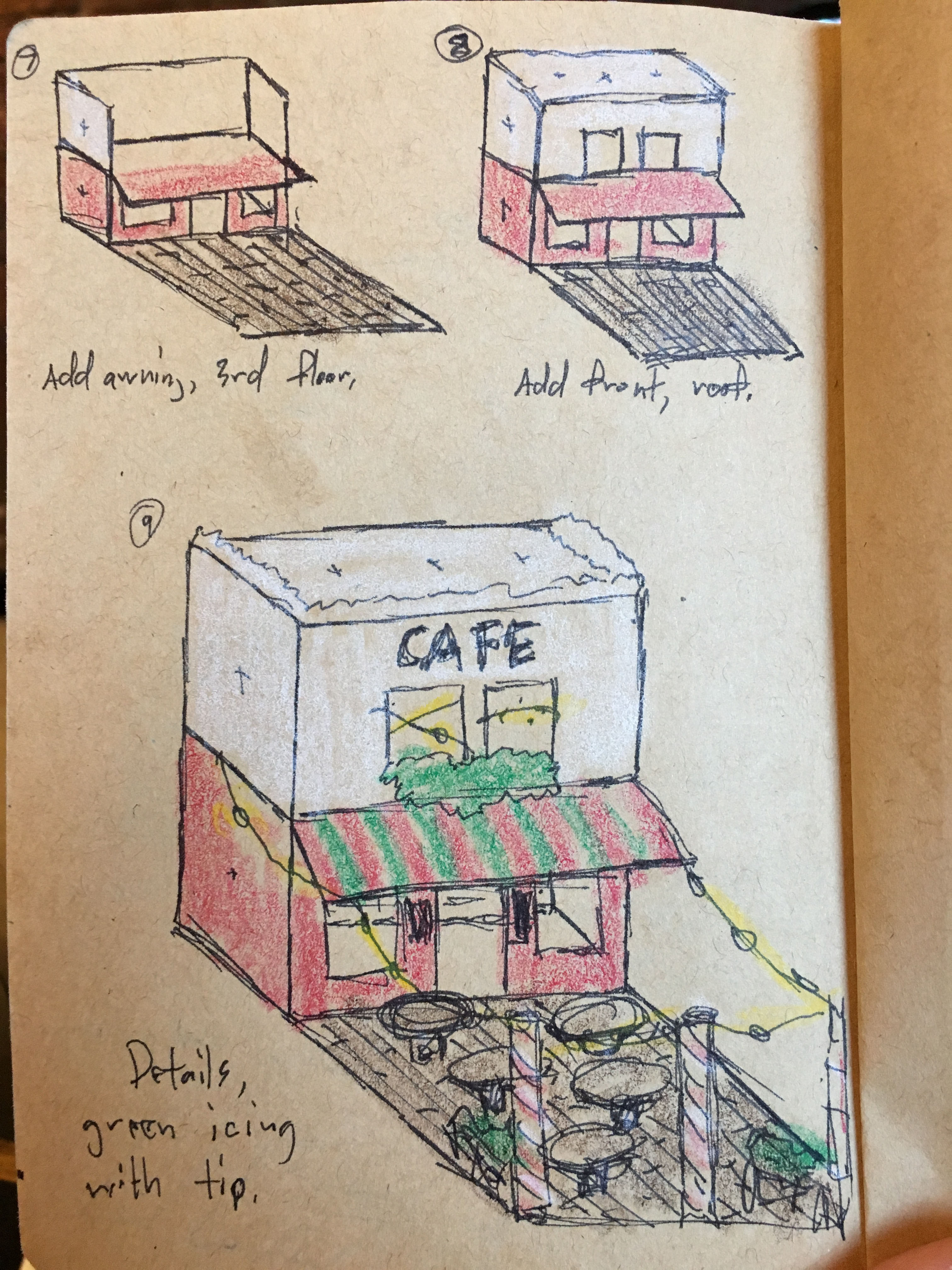
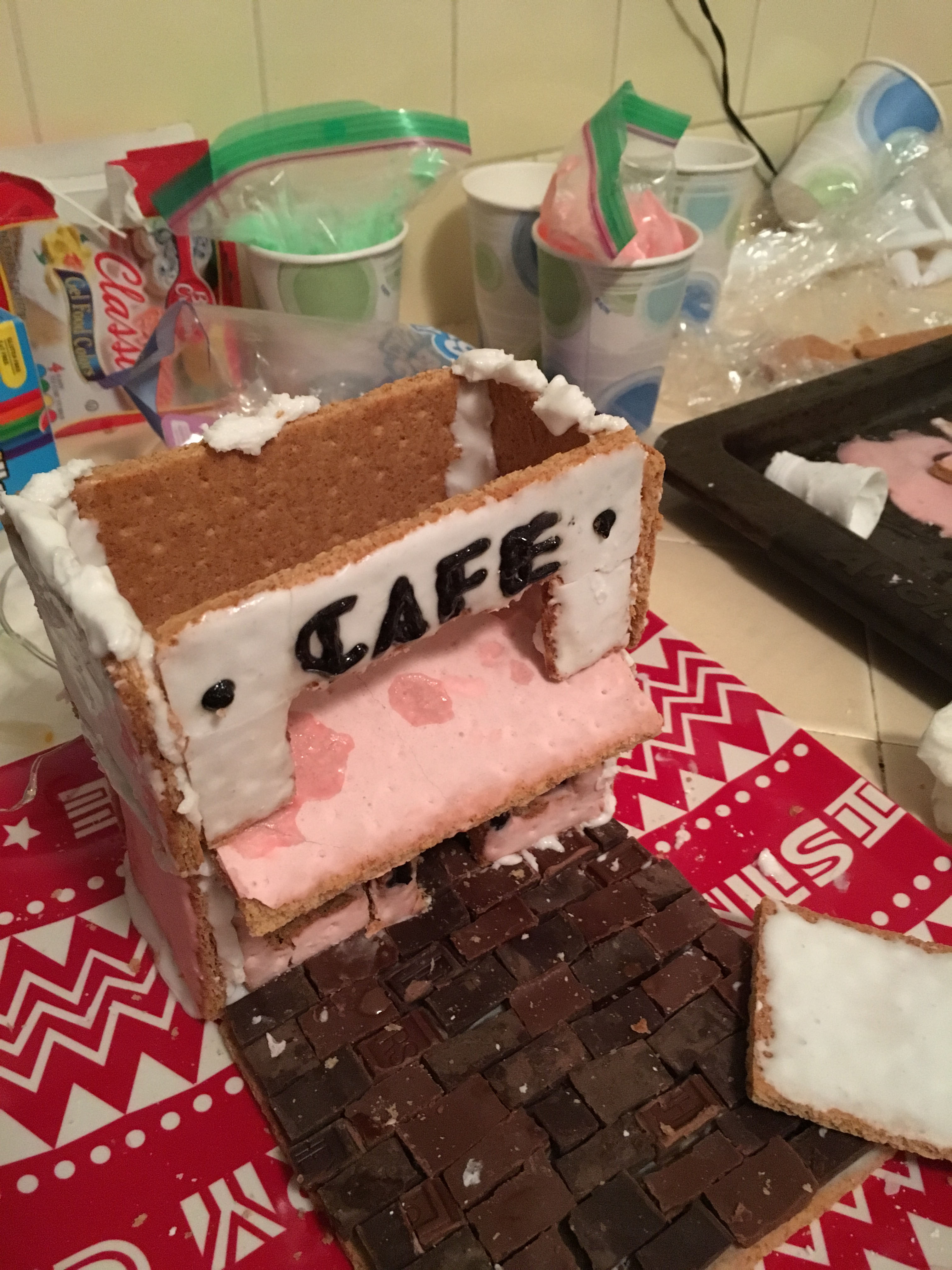
Gingerbread Parisian Cafe


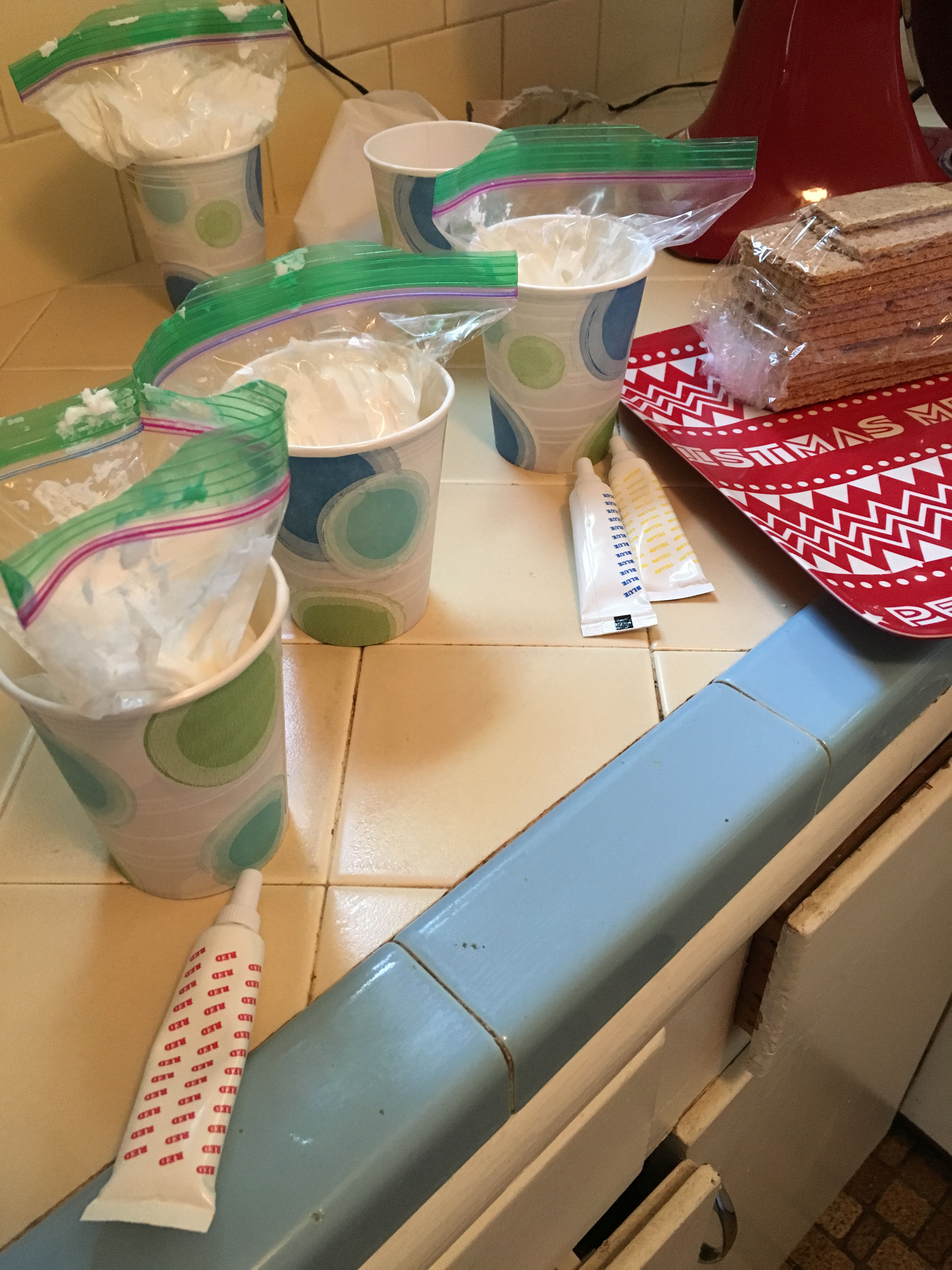
Make up some royal icing. Split it up; dye one batch red, another green. (Keep a bunch white.)

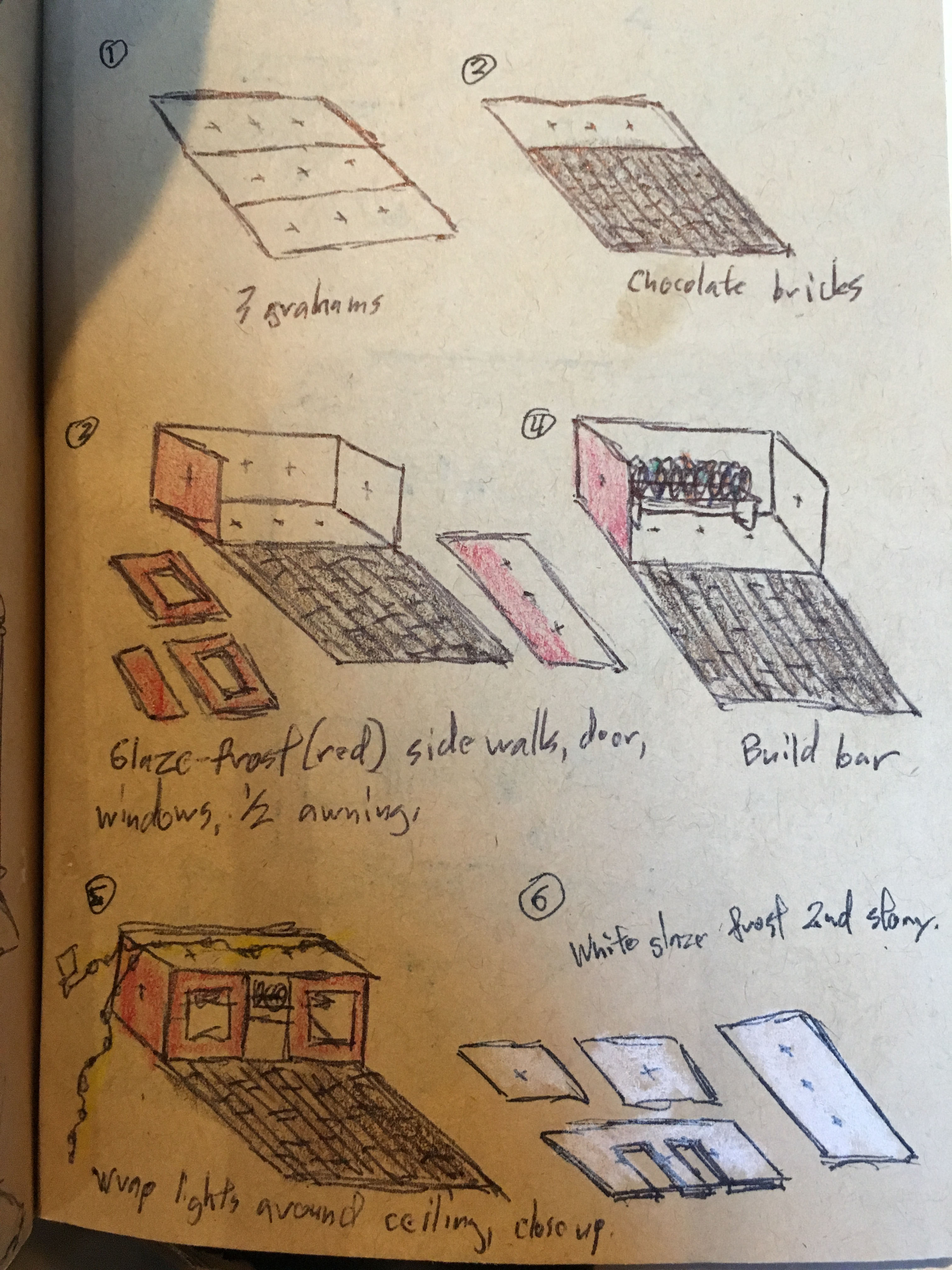
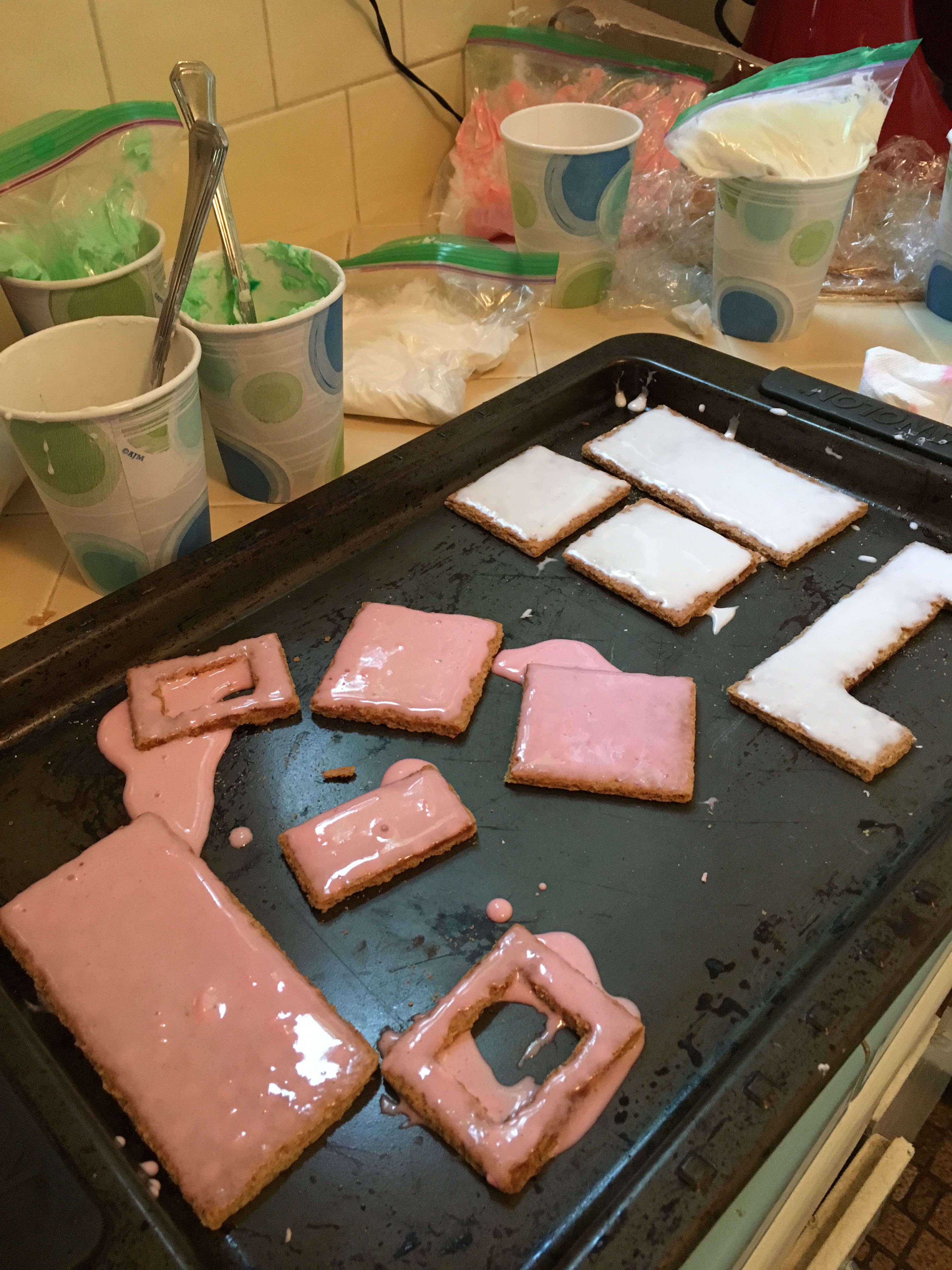
Cut your graham crackers to size per the pattern above. I found that using a sharp paring knife that I kept wetting (since graham crackers turn to mush when damp) and a lot of patient, repeated cuts over the same line worked well.

Royal icing turns to goo with a very small amount of water added. Take some of your red and some of your white; add a little bit of water to each. (Not too much, or you’ll soak the graham crackers, and, well, mush.) Spread the color on the cut pieces as above. Leave them to dry a couple hours.

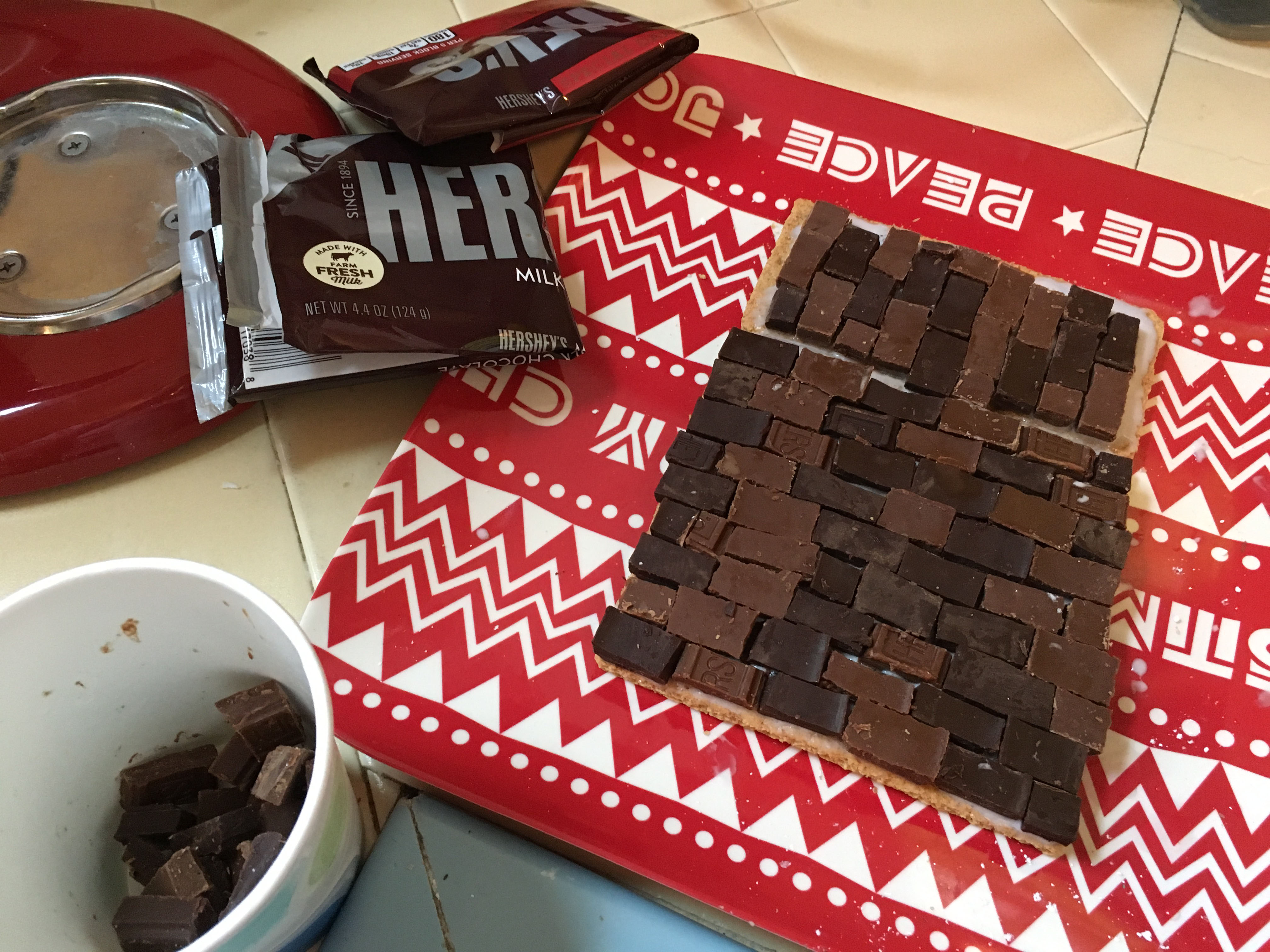
Cut a milk chocolate and a dark chocolate Hershey bar into bricks (4 per rectangle). Glue down the 3 floor graham crackers to the work surface with royal icing. Wet down some more royal icing, adding black food coloring if desired, and spread it out for mortar. Lay down the chocolate bricks, leaving room for the cafe walls to go in.

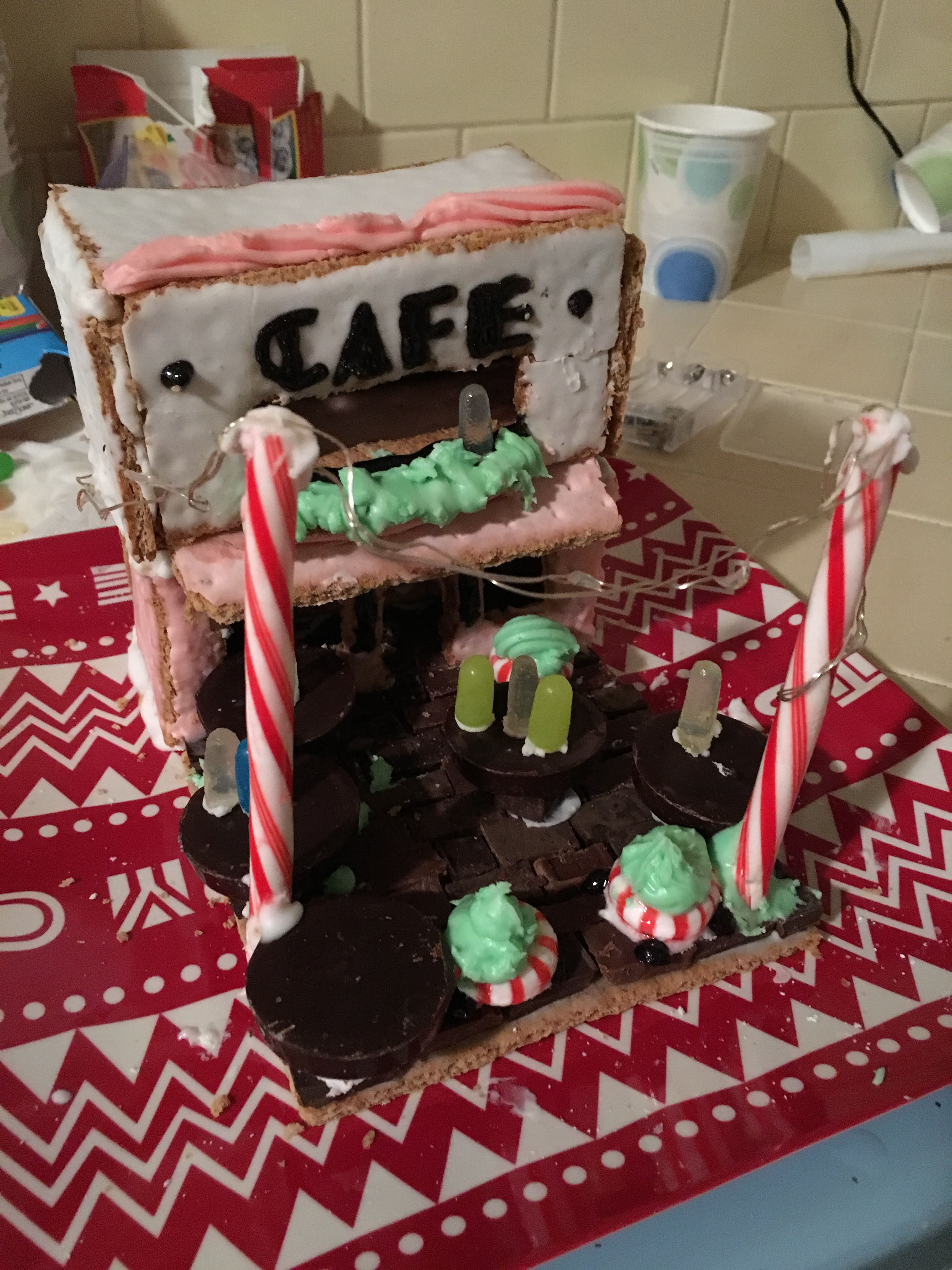
Once the walls are dry, start gluing the pieces together, as shown above. Use an extra piece of graham cracker propped up with leftover bricks for the bar. Soak some Mike & Ikes in warm water to remove the outer coating. Mix & match to fill the bar with bottles. Wrap the mini LED lights a few times around the ceiling of the first floor to light the interior. Leave some extra light wire trailing off to string up as hanging lights.

Add details: Mint chocolates on leftover bricks for tables. Green tip-frosted plants. Mint planters with green tip-frosting plants on top. More Mike & Ike bottles. Candy cane light posts.

The Dream Detective: Case of the Veil of Isis

Episode IX

CASE OF THE VEIL OF ISIS

I

I have made no attempt, in these chronicles, to arrange the cases of my remarkable friend, Moris Klaw, in sections. Yet, as has recently been pointed out to me, they seem naturally to fall into two orders. There were those in which he appeared in the role of criminal investigator, and in which he was usually associated with Inspector Grimsby. There was another class of inquiry in which the criminal element was lacking; mysteries which never came under the notice of New Scotland Yard.

Since Moris Klaw’s methods were, if not supernatural, at any rate supernormal, I have been asked if he ever, to my knowledge, inquired into a case which proved insusceptible of a natural explanation—which fell strictly within the province of the occult.

To that I answer that I am aware of several; but I have refrained from including them because readers of these papers would be unlikely to appreciate the nature of Klaw’s investigations outside the sphere of ordinary natural laws. Those who are curious upon the point cannot do better than consult the remarkable work by Moris Klaw entitled Psychic Angles.

But there was one case with which I found myself concerned that I am disposed to include, for it fell between the provinces of the natural and supernatural in such a way that it might, with equal legitimacy, be included under either head. On the whole, I am disposed to bracket it with the case of the headless mummies.

I will take leave to introduce you, then, to the company which met at Otter Brearley’s house one night in August.

“This is most truly amazing,” Moris Klaw was saying; “and I am indebted to my good friend Searles”—he inclined his sparsely covered head in my direction—“for the opportunity to be one of you. It is a séance? Yes and no. But there is a mummy in it—and those mummies are so instructive!”

He extracted the scent-spray from his pocket and refreshed his yellow brow with verbena.

“How to be regretted that my daughter is in Paris,” he continued, his rumbling voice echoing queerly about the room. “She loves them like a mother—those mummies! Ah, Mr. Brearley, this will cement your great reputation!”

Otter Brearley shook his head.

“I am not yet prepared to make it public property,” he declared, slowly. “No one, outside the present circle, knows of my discovery. I do not wish it to go further—at present.”

He glanced around the table, his prominent blue eyes passing from myself to Moris Klaw and from Klaw to the clean-cut, dark face of Dr. Fairbank. The latter, scarce heeding his host’s last words, sat watching how the shaded light played, tenderly, amid the soft billows of Ailsa Brearley’s wonderful hair.

“Shall you make it the subject of a paper?” he asked suddenly.

“My dear Dr. Fairbank!” rumbled Moris Klaw, solemnly, “if you had been paying attention to our good friend you would have heard him say that he was not prepared, at present, to make public his wonderful discovery.”

“Sorry!” said Fairbank, turning to Brearley. “But if it is not to be made public I don’t altogether follow the idea. What do you intend, Brearley?”

“In what way?” I asked.

“In every way possible!”

Dr. Fairbank sat back in his chair and looked thoughtful.

“Rather a comprehensive scheme?”

Brearley toyed with the bundle of notes under his hand.

“I have already,” he said, “exhaustively examined seven of the possibilities; the eighth, and—I believe, the last—remains to be considered.”

“Listen now to me, Mr. Brearley,” said Moris Klaw, wagging a long finger. “I am here, the old curious, and find myself in delightful company. But until this evening I know nothing of your work except that I have read all your books. For me you will be so good as to outline all the points—yes?”

Otter Brearley mutely sought permission of the company, and turned the leaves of his manuscript. All men have an innate love of “talking shop,” but few can make such talk of general interest. Brearley was an exception in this respect. He loved to talk of Egypt, of the Pharaohs, of the temples, of the priesthood and its mysteries; but others loved to hear him. That made all the difference.

“The discovery,” he now began, “upon which I have blundered—for pure accident, alone, led me to it—assumes its great importance by reason of the absolute mystery surrounding certain phases of Egyptian worship. In the old days, Fairbank, you will recall that it was my supreme ambition to learn the secrets of Isis-worship as practised in early Egyptian times. Save for impostors, and legitimate imaginative writers, no one has yet lifted the veil of Isis. That mystical ceremony by which a priest was consecrated to the goddess, or made an arch adept, was thought to be hopelessly lost, or by others, to be a myth devised by the priesthood to awe the ignorant masses. In fact, we know little of the entire religion but its outward form. Of that occult lore so widely attributed to its votaries we know nothing—absolutely nothing! By we, I mean students in general. I, individually, have made a step, if not a stride, into that holy of holies!”

“Mind you don’t lose yourself!” said Fairbank, lightly.

But, professionally, he was displeased with Brearley’s drawn face and with the feverish brightness of his eyes. So much was plain for all to see. In the eyes of Ailsa Brearley, so like, yet so unlike, her brother’s, he read understanding of his displeasure, I think, together with a pathetic appeal.

Brearley waved his long, white hand carelessly.

“Rest assured of that, doctor!” he replied. “The labyrinth in which I find myself is intricate, I readily admit; but all my steps have been well considered. To return, Mr. Klaw”—addressing the latter—“I have secured the mummy of one of those arch adepts! That he was one is proved by the papyrus, presumably in his own writing, which lay upon his breast! I unwrapped the mummy in Egypt, where it now reposes; but the writing I brought back with me, and have recently deciphered. A glance had showed me that it was not the usual excerpts from the Book of the Dead. Six months’ labour has proved it to be a detailed account of his initiation into the inner mysteries!”

“Is such a papyrus unique?” I asked.

“Unique!” cried Moris Klaw. “Name of a little blue man! It is priceless!”

“But why,” I pursued, “should this priest, alone amongst the many who must have been so initiated, have left an account of the ceremony?”

“It was forbidden to divulge any part, any word, of it, Searles!” said Brearley. “Departure from this law was visited with fearful punishments in this world and dire penalties in the next. Khamus, for so this priest was named, well knew this. But some reason which, I fear, can never be known, prompted him to write the papyrus. It is probable, if not certain, that no eye but his, and mine, has read what is written there.”

A silence of a few seconds followed his words.

“Yes,” rumbled Klaw presently; “it is undoubtedly a discovery of extraordinary importance, this. You agree, my friend?”

I nodded.

“That’s evident,” I replied. “But I cannot altogether get the hang of the ceremony itself, Brearley. That is the point upon which I am particularly hazy.”

“To read you the entire account in detail,” Brearley resumed, “would occupy too long, and would almost certainly confuse you. But the singular thing is this: Khamus distinctly asserts that the goddess appeared to him. His writing is eminently sane and reserved, and his account of the ceremony, up to that point, highly interesting. Now, I have tested the papyrus itself—though no possibility of fraud is really admissible, and I have been able to confirm many of the statements made therein. There is only one point, it seems to me, remaining to be settled.”

“What is that?” I asked.

“Whether, as a result of the ceremony described, Khamus did see Isis, or whether he merely imagined he did!”

Continue reading “The Dream Detective: Case of the Veil of Isis”

Spacehog

I would say the top five Spacehog songs are, in order:

  1. The Meantime
  2. I Want to Live
  3. Beautiful Girl
  4. Mungo City
  5. Zeros